
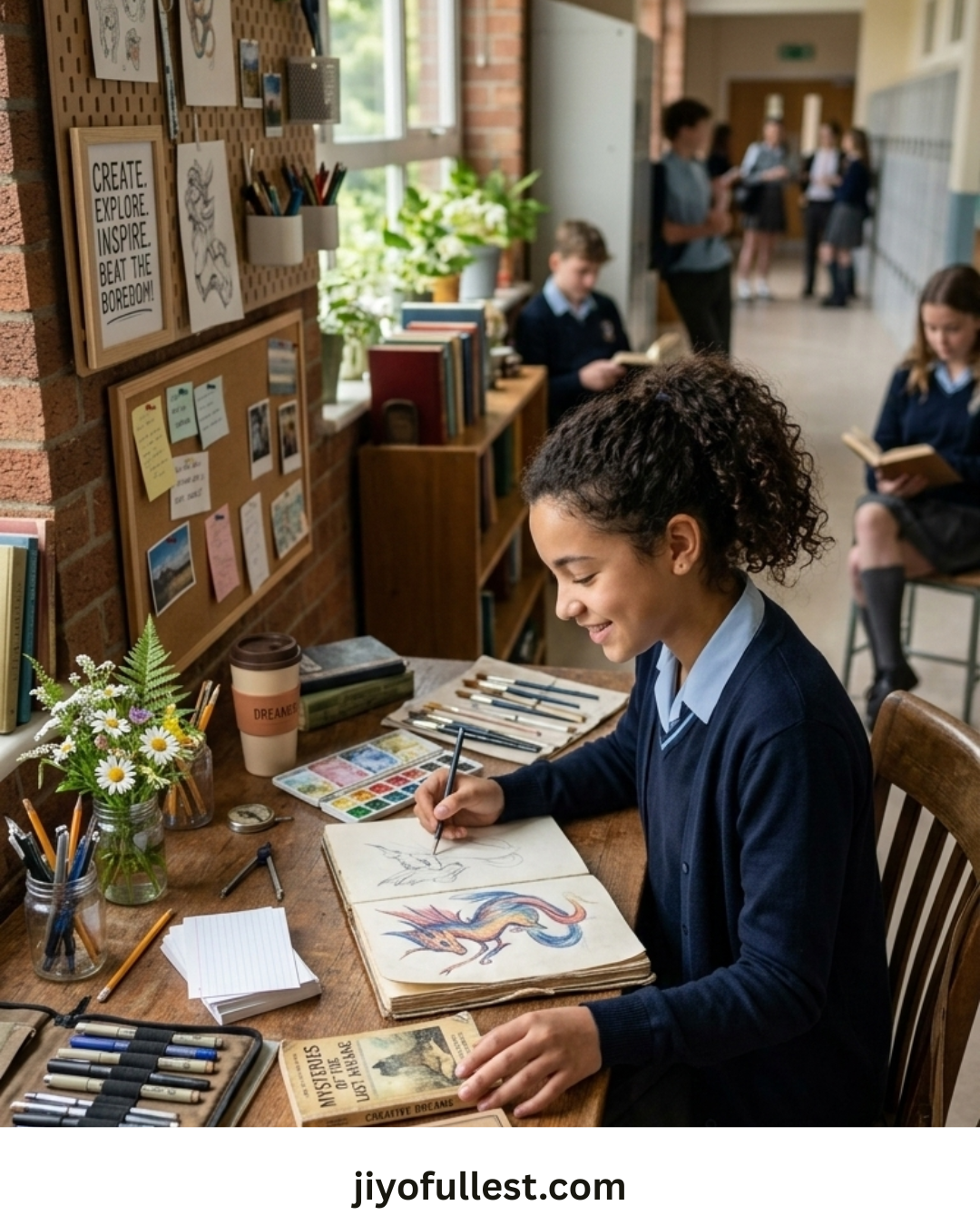
Quick Answer: Things to Do When You're Bored at School
The quietest ways to beat boredom at school are doodling in the margins of your notes, reading a book or comic when your work is done or your teacher allows it, practicing pencil spinning, and playing quiet paper games with a friend. For lunch and free periods, try a walking lap, a conversation game, or getting ahead on homework. If your school allows computers, typing practice and free learning sites are safe picks. Every idea below needs little more than paper and a pen.
That slow moment in class when the clock seems frozen can feel endless. Your mind drifts, the lesson feels miles away from your interest, and the first instinct is to grab your phone. But sometimes phones aren’t allowed — or scrolling just makes the boredom worse.
If you’ve been searching for things to do when bored at school, you’re probably looking for simple ways to stay occupied without getting in trouble or distracting the whole class. The good news is that boredom doesn’t have to mean zoning out completely. There are small, low-key activities you can do at your desk that keep your brain engaged without being obvious.
This guide shares practical ideas that actually work during school hours. Some help pass the time quietly, some make learning a little more interesting, and others simply give your mind something creative to focus on when the day starts dragging.
Sometimes boredom isn’t about the class being impossible. It’s just about needing something to keep your mind active.
Bored at School Right Now? Pick an Idea by How Much Time You Have
If you only have two minutes, choose something that needs no setup at all. Slow breathing, a quick desk stretch, a silent observation challenge, or a few pencil-spinning attempts all work in the gap between one task and the next. These are easy to stop the moment your teacher looks your way.
If you have around ten minutes, you can start something with a small result. Draw a four-panel comic, play a round of dots and boxes with a deskmate, fold a paper crane, or review a handful of flashcards. For example, a student who finishes a worksheet early can use ten minutes for a flashcard sprint and still be ready when the class moves on.
If you have a whole period or a free block, pick a longer project, such as writing the opening of a story, getting ahead on tomorrow’s homework, or exploring something new in the library. If you are stuck mid-lesson and want ideas built for exactly that, our guide on 50 things to do when bored in class goes deeper on quiet in-class options.
1. Doodle in the Margins of Your Notebook
Doodling is one of the easiest things to do when bored at school because it looks like normal note-taking from a distance.
You can draw small patterns, cartoon characters, shapes, or even design imaginary logos. Many students start with simple repeating patterns like spirals, stars, or geometric shapes.
Interestingly, doodling can also help with focus. When your hands stay lightly engaged, your brain is less likely to drift completely away from the lesson.
For example, you might draw a small vine pattern along the edge of your notes while still listening to the teacher. It keeps your mind active without being disruptive.
2. Turn Your Notes Into Visual Diagrams
Transforming notes into diagrams can make boring material slightly more interesting.
Instead of writing plain sentences, try drawing arrows, flow charts, or little icons next to key ideas. History timelines, science processes, or vocabulary words can all be organized visually.
This works well because it activates creativity while still keeping you connected to the lesson.
A student studying biology might sketch a rough diagram of a plant cell while the teacher talks, turning a dry concept into something easier to remember.
3. Create Tiny Comics
Drawing mini comics is a fun way to pass time discreetly.
Use the corner of your notebook page and create a simple four-panel story. It doesn’t need to be complex. Maybe it’s about a pencil going on an adventure or a funny classroom moment.
These little comics are quick, creative, and easy to hide within your notes.
Over time, you might even build a small collection of characters or running jokes.
🎓 Planning What Comes Next?
AI skills, careers, side hustles, and smart choices for using AI wisely — everything to get a head start.
Want a guided plan instead of just articles?
Get the Teen Future Skills & Career Starter Kit → $9.994. Write Short Stories or Random Ideas
Creative writing can be surprisingly engaging when you’re bored.
Start with a random sentence like:
“A mysterious package appeared on my desk.”
Then continue the story for a few paragraphs whenever you have free moments.
The story doesn’t need to be perfect or even finished. The goal is simply to give your imagination something to play with.
Many students find that storytelling makes time pass much faster
5. Invent Quiet Word Games
Word games are great for keeping your brain active without drawing attention.
You can challenge yourself to:
Think of as many words as possible starting with a certain letter
Create rhyming words for something the teacher says
Build a long word chain where the last letter starts the next word
These games work especially well during slower lessons because they stimulate your mind without requiring materials.
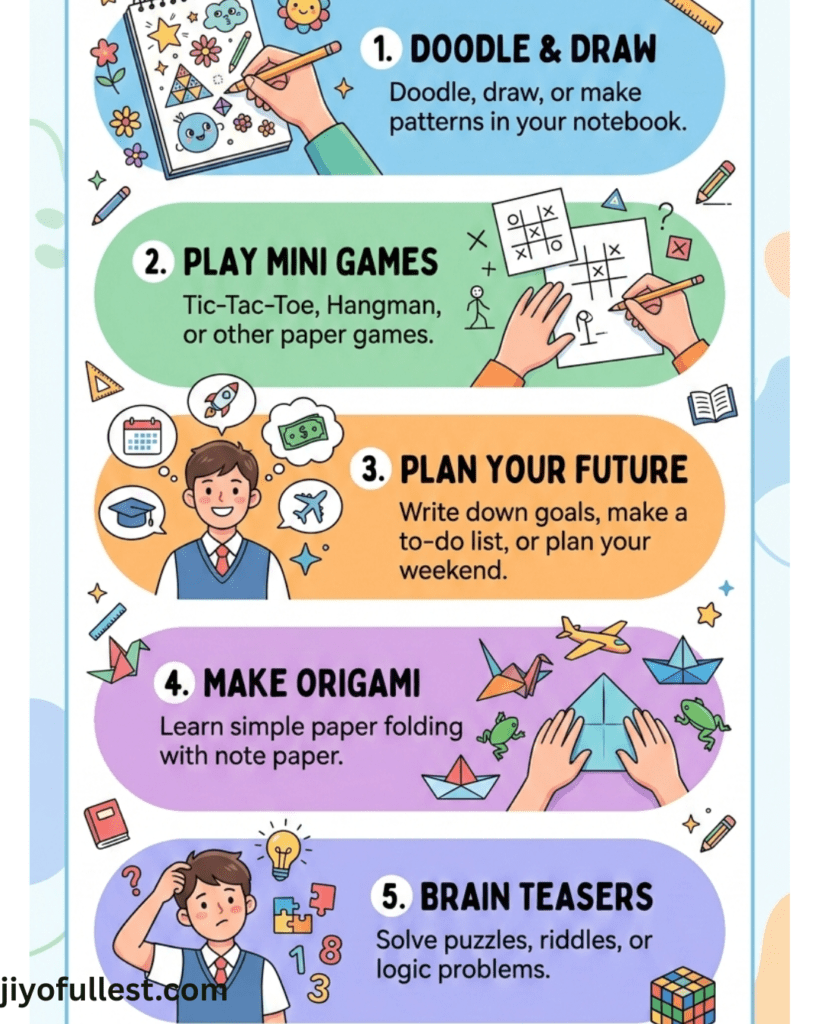
6. Plan Something You're Excited About
Future planning can make boring moments feel productive.
Use the time to think about something fun coming up — a weekend plan, a trip, a birthday, or even a personal goal.
Write down ideas, possible activities, or things you want to try.
For example, you might plan a small movie night with friends or list places you’d like to visit in your city.
Turning boredom into planning time helps your brain shift from frustration to anticipation.
If you enjoy planning ahead, you might also find ideas in our guide on fun things to do by yourself on a weekend — it covers creative solo activities that are easy to organise with nothing but free time and curiosity.
😌 Bored, Stressed, or Just Need Ideas?
Hobbies, books, group activities, and real ways to handle teenage stress — for when school feels like a lot.
7. Improve Your Handwriting
Practicing handwriting might sound simple, but it can be oddly satisfying.
Choose a few sentences from your notes and rewrite them slowly using different styles — cursive, block letters, or calligraphy-inspired lettering.
You can also experiment with headings, underlines, and decorative styles for titles.
Over time, your notes start to look cleaner and more visually appealing.
8. Challenge Your Memory
Memory challenges are quiet mental games you can play anywhere.
Look around the classroom for 10 seconds. Then look down and try to remember everything you noticed: colors, objects, posters, or classmates’ clothing.
You can also try memorizing short lists or recalling details from earlier in the day.
These exercises strengthen focus and attention while keeping boredom away.
9. Create a Small Personal Goal List
Goal lists give your mind something constructive to think about.
Write down small goals you’d like to achieve over the next few weeks. They don’t have to be serious.
Examples might include:
Finish reading a certain book
Learn a simple recipe
Practice drawing more often
Try a new hobby
If you want a bigger list of ideas specifically for when you’re stuck in class, our guide on 50 things to do when bored in school covers everything from quiet games to productive ways to use dead time between lessons.
Thinking about goals gives boredom a productive direction.
10. Draw Maps From Memory
Memory maps are a surprisingly fun challenge.
Try drawing a map of your neighborhood, school layout, or route from home to school without looking at anything.
Include streets, landmarks, parks, or stores you remember.
It turns boredom into a small puzzle and strengthens spatial memory at the same time
11. Practice Silent Observation
Observation exercises are simple but powerful.
Pick one object in the classroom — maybe the clock, a backpack, or a plant. Spend a minute studying it carefully.
Notice details you usually ignore: textures, shadows, shapes, and colors.
This activity improves attention and can even make ordinary environments feel more interesting.
12. Learn Something Small Each Day
Micro-learning is a great way to turn boredom into growth.
Choose something simple to learn each day, like:
A new word
A historical fact
A math trick
A foreign language phrase
Write it down and see if you can remember it later.
Small pieces of knowledge accumulate surprisingly quickly.
13. Create a Personal Idea List
Idea lists are perfect for moments when your mind is wandering.
Write headings like:
Movies I want to watch
Books I want to read
Places I want to visit
Skills I want to learn
Then add ideas whenever they pop into your mind.
Over time, these lists become helpful references for future plans.
If you want to use downtime productively, there are some genuinely interesting creative ways teens are using AI in school that go well beyond homework help.
14. Make Up Brain Teasers
Brain teasers are fun challenges you can invent yourself.
Create small puzzles like:
Riddles
Math tricks
Logic questions
Then try solving them later or sharing them with friends.
This keeps your mind engaged without requiring much space or attention.
15. Practice Mindful Breathing
Sometimes boredom is actually mental fatigue.
Mindful breathing can reset your focus without anyone noticing.
Take slow breaths and pay attention to the rhythm of your breathing for a minute or two. It helps calm racing thoughts and improves concentration.
Many students find that a short breathing break makes the rest of the class easier to sit through.
If you find that boredom at school often follows you home and turns into restless, racing thoughts at night, our guide on how to stop overthinking at night has practical techniques to help your mind properly switch off once the school day is done.
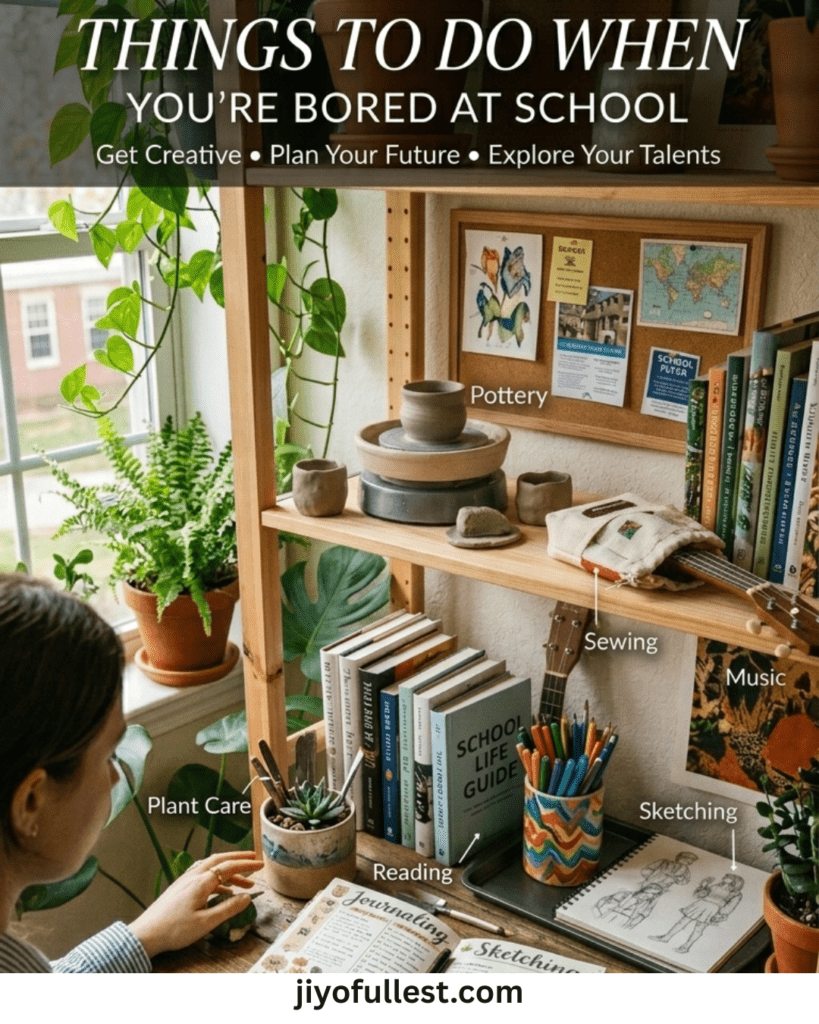
16. Read a Book, Magazine, or Comic Discreetly
Discreet reading is one of the simplest things to do when bored at school, and it barely looks like you’re doing anything unusual.
Keep a paperback, comic, or even a folded magazine article tucked behind your textbook or inside a folder. Flip to it during slow stretches of class when the teacher isn’t directly addressing you.
This works especially well during independent work time, or when a lesson has clearly wrapped up early for you specifically.
For example, a student who finishes a worksheet ten minutes before everyone else might spend those minutes with a few pages of a novel instead of just staring at the clock.
17. Play Classic Quiet Paper Games With a Deskmate
Paper and pencil games are some of the most reliable stuff to do in school when you have a friend sitting nearby.
Hangman, tic-tac-toe, dots and boxes, and MASH can all be played silently on a shared scrap of paper passed back and forth. None of them need more than a pencil and a torn corner of notebook paper.
These games work well because they’re fast, easy to hide under a textbook, and don’t require anyone to talk.
For example, two students bored in the same slow class can trade a game of dots and boxes across an entire period without either of them saying a word.
18. Try Simple Origami
Origami turns a spare sheet of paper into a quiet, focused activity that keeps your hands busy.
Start with something simple like a paper crane, a fortune teller, or a basic paper airplane. Most folds only take a few minutes and don’t require instructions beyond what you already remember.
This is a good option when your mind needs a break from thinking entirely, since folding paper is almost purely physical.
Over a semester, some students end up with a small collection of folded shapes without ever noticing where the time went.
19. Do Subtle Desk Stretches
Desk stretches address the fact that boredom in class is sometimes more physical than mental.
Try slow neck rolls, shoulder shrugs, or gently stretching your wrists and fingers under the desk. Pressing your palms together and holding for a few seconds also works as a quiet isometric stretch.
Small movements like these reset restlessness without drawing any attention.
If a long lecture has left your body as tired as your mind, a minute of subtle stretching can make the second half of class feel more manageable.
20. Have a Plan for When You Finish Work Early
Finishing early is one of the most common reasons students end up bored in class in the first place.
Rather than sitting with nothing to do, keep a running list of what to move on to. That could be reviewing notes from an earlier class, starting the next assigned reading, or working through one of the other ideas on this list.
Having a default next step means you’re never stuck waiting for the teacher to notice you’re finished.
For example, a student who finishes a math worksheet early might use the extra ten minutes to review flashcards for tomorrow’s quiz instead of watching the clock.
21. Quiz Yourself With Flashcards
Self-quizzing turns dead time into review time.
Keep a small stack of flashcards in your bag for whatever you’re currently studying, whether that’s vocabulary, formulas, or historical dates. Flip through a few whenever a lesson slows down or you finish an assignment early.
This is especially useful in the days leading up to a test, when a few extra minutes of review each day adds up.
A stack of five or six cards is small enough to keep in a pocket and pull out without anyone noticing.
22. Organize Your Backpack or Binder
Organizing might not sound exciting, but it’s a genuinely useful way to fill a few spare minutes.
Sort loose papers into the right sections, throw out anything you don’t need, or reorganize your binder by subject. It’s a low-effort task that still feels productive.
Doing this regularly also means less scrambling to find things later, which saves time outside of class too.
A five-minute tidy-up during a slow lesson can save you from digging through a messy folder during your next class.
Things to Do at Lunch, Free Periods and Spare Minutes
Boredom at school is not only a classroom problem. Lunch breaks, study halls, and the awkward gaps between lessons can feel just as slow. These six ideas fit those moments.
23. Take a Walking Lap Outside With a Friend
Fresh air and gentle movement shift your mood faster than almost anything else on a slow school day. If your school allows you outdoors at lunch or recess, walk a loop of the field or courtyard with a friend and talk about anything except homework.
For example, a ten-minute lap at the start of lunch leaves you more relaxed for the afternoon. Next lunch, suggest it to one person and make it a habit.
24. Play a Conversation Game at the Lunch Table
Games like Would You Rather, 20 Questions, and Two Truths and a Lie turn a quiet table into something fun, and they need nothing but people. They also help you learn surprising things about friends you thought you already knew.
Come with three questions ready, such as “Would you rather be able to fly or be invisible?” and let the group take it from there.
25. Get Ahead on Tomorrow’s Homework During Study Hall
Study hall is the easiest place to turn dead time into free evening time. Start with the assignment you like least, because finishing it first makes the rest of the day feel lighter.
Even fifteen minutes on tomorrow’s reading or a short worksheet can mean an evening with no homework hanging over you. Pick one task today and see how it feels.
26. Explore a New Section of the Library
Most students stay in the same two shelves. Spend a free period wandering a section you have never browsed, like graphic novels, science magazines, true crime, or art books, and borrow whatever catches your eye.
This works well because libraries are quiet and expected places, so no one questions why you are there. Try one genre you would normally skip.
27. Join or Start a Club
Persistent boredom at school often means there is no part of the day you look forward to. A club, such as chess, art, coding, drama, or a book group, can change that by giving you a regular reason to show up.
If a club you want does not exist, ask a teacher whether you could start one. This week, find out when the next meeting of any club takes place and go to one session.
28. Practice Pencil Spinning or Pen Tricks
Pencil spinning is a quiet, low-effort skill that keeps your hands busy and gives you a visible goal. Start with a simple thumb spin, then work toward a full rotation around your thumb and fingers.
Practice when your work is finished or during a quiet moment, and stop if the pencil starts clattering. Five minutes a day is enough to see improvement within a week.
Things to Do on a School Computer or Chromebook (If Your School Allows It)
If your school gives you a computer, some of the most useful boredom fixes are online. Always follow your school’s rules and stick to approved sites. If your school allows games, see our guide on fun computer games to play when bored.
29. Practice Typing Speed
A free typing practice site turns spare minutes into a skill you will use for years. Short daily sessions build speed faster than one long session a week.
Aim to beat your own score each day rather than comparing with others. Ten minutes a few times a week is enough to notice progress within a month.
30. Learn a Few Keyboard Shortcuts
Shortcuts like copy, paste, undo, and switching between tabs save real time on every assignment. Learn two a day and practice them until you stop thinking about them.
Write them on a sticky note beside your screen as a reminder. By the end of the week, your schoolwork will feel noticeably faster.
31. Explore Google Arts and Culture
Google Arts and Culture lets you take virtual tours of museums, zoom in on famous paintings, and explore stories from history. It is educational enough to be school-appropriate and interesting enough to be fun.
Pick one museum or one artist and spend ten minutes exploring. If something catches your attention, you may find a project idea for class.
32. Learn a Language in Short Bursts
Free language apps break learning into five-minute lessons, which fit neatly into spare minutes. Choose one language you are curious about and commit to a few minutes each day.
Consistency beats length here. A streak of short daily lessons builds more than one long weekend session.
33. Build a Flashcard Deck Online
Making your own flashcards forces you to pick out what matters in a topic, which is already half of studying. Free flashcard tools let you build a deck for any subject and quiz yourself later.
Start with the next test you have coming up. A deck of twenty cards made in spare minutes becomes a ready-made review set.
Things to Do at School With a Friend
Boredom is easier to beat when someone is in on it. These five ideas work quietly at a shared desk, at lunch, or during free time.
34. Write a Shared Story One Line at a Time
Pass a notebook back and forth and each add one sentence. Within a few minutes you will have a story that goes places neither of you planned.
Start with a strange opening line, like “The school bell rang, but nobody was in the building.” Keep it going across several days.
35. Quiz Each Other Before a Test
Taking turns asking questions is one of the most effective ways to study, and it feels much less like studying when you do it with a friend. Switch roles every few questions to keep it light.
Use your notes or a flashcard deck and set a target, such as ten questions each, before you switch topics.
36. Draw a Collaborative Comic or Fold-Over Drawing
Fold a sheet of paper into sections. Each person draws one part of a creature, such as the head, body, or legs, without seeing what the other drew, then unfold to see the result.
The results are almost always funny, and the game needs only paper and a pencil.
37. Invent a Simple Secret Code
Create a code where letters are replaced by numbers or symbols, then pass short messages back and forth. It is quiet, creative, and very hard for anyone else to read.
Agree on a key with your friend and write it down in a safe place. Start with short messages and build up to full notes.
38. Plan Something to Look Forward To Together
Boredom often fades when there is something ahead to anticipate. Plan a weekend meetup, a movie night, or a small project with a friend and use spare minutes to work out the details.
Writing the plan down makes it feel real. This week, choose one event and pick a date.
Two More Quiet Ideas for Any Moment of the Day
39. Write a Letter to Your Future Self
Write a short letter to yourself a year from now. Say what you are doing these days, what you hope will change, and one thing you want to remember about this school year. It needs only paper and a pen, and it looks like normal note-taking.
Fold it, write the date on the outside, and keep it somewhere safe. Reading it next year is surprisingly fun.
40. Learn Ten Words in Another Language
Pick a language you are curious about, such as Spanish, French, Japanese or sign language, and learn ten useful words or phrases. Write them on a small card and quiz yourself in spare minutes.
If you have school computer access, a free learning site can help with pronunciation. Add five new words each week and you will have a real starter vocabulary by the end of term.
Why School Boredom Happens
Boredom in school is extremely common.
Classes sometimes move more slowly than your natural attention span, or the subject simply doesn’t connect with your interests. Your brain looks for stimulation, which is why phones feel so tempting.
The key isn’t eliminating boredom completely — that’s unrealistic. Instead, it’s learning small ways to stay mentally active during slower moments.
Activities like drawing, writing, or quiet mental games give your brain something to do without causing distractions.
Over time, these habits can even make long classes feel shorter.
Boredom can also be a sign that you need more stimulation than a standard school day offers. If you’re the kind of person whose mind is always looking for something new to explore, our list of hobbies to pick up when you’re bored with everything is worth a look — it covers creative, physical, and digital hobbies that work for teenagers with different interests and energy levels.
Is It Normal to Be Bored at School? When to Talk to Someone
Yes. Being bored at school sometimes is very common and does not mean anything is wrong with you. Lessons move at one pace for a whole class, so most students find some parts too slow, too repetitive, or not interesting to them. Occasional boredom is a normal reaction to that.
It is worth paying attention if boredom is constant, if it comes with trouble focusing in every setting, or if it affects your grades or mood. Some students are bored because the work is too easy and they need more challenge, while others are bored because they find it hard to concentrate. The two can look similar from the outside, which is why it helps to talk to someone who knows you.
If this sounds like you, tell a teacher, school counselor, or parent what you are noticing and ask for ideas. For parents, signs that boredom may be more than a passing mood include a child who is frequently restless, dreads school, or says nothing they learn is interesting. A conversation with the teacher is a good first step, and a doctor or school psychologist can help if difficulty concentrating seems to be a wider pattern. This is general information and not a diagnosis.
How to Stay Engaged Without Getting in Trouble
If you try these ideas, keep a few things in mind.
First, stay respectful of the classroom environment. Activities should be quiet and subtle so they don’t disrupt others.
Second, avoid anything that completely disconnects you from the lesson. The goal isn’t to ignore the class — it’s to stay mentally active during slower moments.
And finally, rotate between different activities so they don’t become boring themselves.
Even small changes can make a long school day feel much easier.
💰 WEALTH & MONEY CALCULATORS
Discover Your Financial Luck & Money Energy
Conclusion
Being bored at school is something almost every student experiences. Long lessons, repetitive routines, and limited freedom can make time feel slow. But boredom doesn’t have to mean staring at the clock or reaching for your phone.
Simple activities like doodling, writing mini stories, playing quiet word games, or practicing observation can keep your mind engaged while still respecting the classroom environment. These small habits turn idle moments into opportunities for creativity, curiosity, and focus. And if you’re looking for something more active to do once school is over for the day, our guide on fun computer games to play when bored covers browser-based and free games you can jump into instantly — no downloads, no setup.
Sometimes the difference between a dull class and a manageable one is just having a few ideas ready when your mind starts to wander.
🎓 Planning What Comes Next?
AI skills, careers, side hustles, and smart choices for using AI wisely — everything to get a head start.
Want a guided plan instead of just articles?
Get the Teen Future Skills & Career Starter Kit → $9.99Things to Do When You're Bored at School – FAQ
Why do I get bored at school so easily?
Boredom at school usually happens when lessons move slower than your attention span or when the topic doesn’t immediately feel interesting. Your brain naturally looks for stimulation, which is why you might feel restless or distracted during long classes.
It’s a common experience for many students and doesn’t necessarily mean you dislike learning. Often, it just means your mind needs small ways to stay engaged.
Is it bad to be bored in class sometimes?
Not necessarily. Occasional boredom is normal and can even encourage creativity. When your brain isn’t constantly stimulated, it sometimes starts generating new ideas or thoughts.
The key is finding quiet activities that help you stay mentally active without distracting the class.
What can I do when phones are not allowed in school?
There are many phone-free options that are still fun and subtle. Activities like doodling, writing short stories, creating word games, practicing handwriting, or drawing memory maps can keep your mind busy while still looking like normal notebook work.
These kinds of activities are especially helpful in classrooms where devices aren’t allowed.
Can doodling actually help with focus?
Yes, for many people it can. Light doodling keeps your hands occupied, which can help prevent your mind from drifting too far away from the lesson.
It works best when the drawings are simple patterns or small sketches that don’t require intense concentration.
How do I stay engaged in class without getting in trouble?
Choose activities that are quiet, small, and easy to hide within your notes. For example, doodling in the margins, organizing notes visually, or writing short creative ideas are usually safe options.
The goal is to stay mentally active without disrupting the class or ignoring the lesson completely.
What if every class feels boring?
If boredom happens in most classes, it may help to mix small mental challenges into your routine. Creating mini games, writing creative ideas, or setting personal learning goals during class can make the day feel less repetitive.
Sometimes simply changing how you take notes or interact with the material can make a big difference.
Can boredom in school affect learning?
It can if it leads to completely zoning out. When boredom becomes constant, students may stop paying attention to important information.
Finding small ways to stay engaged — even through quiet creative activities — can help maintain focus and improve memory of what’s being taught.
How can I make school feel less repetitive?
Trying different note-taking styles, setting small personal challenges during class, or using free moments for creative thinking can help break the monotony.
Even small changes in how you use your time during lessons can make the school day feel more interesting and productive.
Do these ideas work for middle school and high school students?
Yes. Nearly every idea on this list, from quiet paper games to discreet reading to flashcard review, works regardless of grade level.
Middle schoolers often get the most out of paper games and origami, while high schoolers tend to lean more on flashcard review and organizing time between classes. The core idea stays the same at any age: keep your hands or mind lightly occupied without disrupting the lesson.
How do I pass 30 minutes in class when I’m bored?
Break the half hour into three ten-minute blocks. Spend the first on a quiet creative task such as doodling or a four-panel comic, the second on a small mental challenge such as a brain teaser or memory game, and the third on something useful such as reviewing notes or flashcards. Smaller blocks make time pass more quickly than watching the clock.
What can I do on a school computer when I’m bored?
If your school allows it, try typing practice, learning keyboard shortcuts, exploring Google Arts and Culture, taking short language lessons, or building a flashcard deck. These are generally accepted as school-appropriate. Always check your school’s rules first.
Are there games I can play when bored at school?
Quiet paper games like hangman, tic-tac-toe, and dots and boxes work in almost any classroom. If your school allows computer games, our guide on fun computer games to play when bored lists options, and our list of things to do when bored in class includes unblocked-style choices.
What should I do at lunch when I’m bored?
Take a walking lap outside, start a conversation game at your table, visit the library, or use the time to get ahead on homework. If your lunch period is long, joining a club that meets at lunch is one of the best fixes.
What can I do when I’m bored at school and have no friends nearby?
Solo options work well: read in the library, draw, write, practice a skill such as pencil spinning, or take a walk. Clubs are also one of the easiest ways to meet people because everyone there already shares an interest.
Is being bored at school a sign of ADHD?
Not by itself. Boredom is a normal reaction to slow or repetitive lessons. However, if you notice that you struggle to concentrate in many settings, not only at school, it is worth speaking with a doctor or school counselor. This is general information and not a diagnosis.
Recent Posts
- Best Freelance Skills for Teens in 2027: 12 Skills to Learn First (and How to Choose)
- Best Homework Help Websites in 2027: 25 Free and Paid Sites for Every Subject
- How to Build a Writing Portfolio as a Teen With No Experience
- Best Skincare Routine for a Natural Glow (Morning & Night)
- Hair Glow Up: Grow Healthier Hair From the Inside Out