Quick Answer
Can Teens Rely on AI?
Teens can rely on AI as a support tool, not a sole authority — it's genuinely useful for learning and creativity, but comes with real risks around bias, privacy, misinformation, and emotional over-reliance. This guide covers what the research actually shows, including the growing trend of teens turning to AI for companionship rather than just schoolwork, and practical ways to use AI responsibly.
Teens Using AI for Schoolwork
Over 50%
Teens Using AI for Emotional Support
~12%
Main Risks
Bias • Privacy • Dependency
Verdict
Support Tool, Not Authority
Source
Pew Research Center
Artificial Intelligence (AI) is shaping the way teens learn, communicate, and even express creativity. From AI chatbots that help with homework to apps that generate art or music, AI feels like a helpful companion in the digital age. But the big question remains: can teens truly rely on AI?
The answer isn’t simple. AI can be incredibly useful, but it comes with risks like bias, misinformation, privacy concerns, and the potential to affect mental health.
This guide focuses specifically on bias, safety, and mental balance. For the full picture on AI and teenage life, covering tools, careers, creativity, and academic integrity alongside safety, see our complete AI and teens guide.
This blog aims to guide teens on how to use AI responsibly while keeping safety and mental balance at the center.
What the Research Actually Shows
This isn’t just a theoretical question — real research backs up how widespread teen AI use already is. According to Pew Research Center, over half of U.S. teens report using AI chatbots for schoolwork, and roughly 12% have used them specifically for emotional support rather than academic help. The American Psychological Association has gone as far as issuing a formal health advisory on AI and adolescent well-being, recommending stronger safeguards as adoption among youth continues to grow rapidly.
These numbers matter because they show AI use among teens isn’t a fringe behavior or a distant future concern — it’s already a mainstream part of how a majority of teens navigate school and, for a meaningful minority, their emotional lives too. That’s exactly why understanding the real risks and smart practices covered in this guide matters now, not eventually.
The Promise of AI for Teens
For teens, AI opens doors to new opportunities:
-
Education Support – AI-powered tools explain tough concepts, create practice quizzes, and even assist with writing.
-
Creative Boost – Teens can generate artwork, write stories, or compose music with AI tools.
-
Career Preparation – Learning AI today gives teens an edge in future job markets.
-
Personal Assistance – From health reminders to time management apps, AI helps teens stay organized.
AI can act like a supportive mentor or partner—but only if it’s used wisely.
🎓 Planning What Comes Next?
AI skills, careers, side hustles, and smart choices for using AI wisely — everything to get a head start.
Want a guided plan instead of just articles?
Get the Teen Future Skills & Career Starter Kit → $9.99The Risks of Relying Too Much on AI
1. Bias in AI Responses
AI is trained on data created by humans. If that data includes stereotypes or unfair assumptions, AI can unintentionally pass them on. For example, it might favor certain perspectives or leave out important voices. Teens must understand that AI isn’t always neutral.
2. Safety and Privacy Concerns
AI tools often collect data, and sharing personal details can create risks. Teens should be careful not to share private information such as home addresses, school names, or personal photos with AI platforms.
3. Misinformation and Accuracy
AI can sometimes “hallucinate,” giving answers that sound convincing but are factually wrong. Relying on such information without cross-checking can lead to misunderstandings.
4. Mental Balance
Overusing AI chatbots or apps can make some teens less engaged in real-life activities. It can also create dependency, where teens feel they can’t solve problems without AI. Finding balance is key.
5. AI Companionship: When Teens Turn to AI Instead of People
A newer and increasingly discussed risk goes beyond homework help or misinformation — some teens are turning to AI chatbots for companionship, using them the way they might confide in a friend rather than as a tool for tasks. Mental health professionals have noted this trend specifically, pointing out that AI can feel safe, private, and non-judgmental in a way that makes it appealing during difficult moments — but it isn’t a substitute for real human connection, and it can’t provide genuine emotional support the way a trusted person can.
This distinction matters more than it might seem. Using AI to brainstorm how to approach a hard conversation with a friend is different from using AI as a replacement for having that conversation with an actual person. If a teen finds themselves consistently choosing AI conversation over reaching out to friends, family, or a counselor, that’s worth noticing as a pattern rather than dismissing as harmless habit.
✨ Discover Your Lucky Colors, Days & Numbers
Everything you need to align your finances with the right timing and energy.
Smart Ways Teens Can Use AI
1. Double-Check Information
AI can be a great source of ideas, but facts should always be confirmed with trusted resources—teachers, books, or verified websites.
2. Protect Your Privacy
A golden rule: if you wouldn’t share something with a stranger, don’t share it with AI. Avoid entering sensitive details into chatbots or apps.
3. Use AI for Learning, Not Cheating
Instead of asking AI to write essays or solve math problems directly, teens can use it to learn step-by-step solutions or brainstorm ideas. This way, AI supports growth rather than replacing effort.
4. Balance Digital and Offline Life
AI is powerful, but so is spending time with family, friends, and hobbies. Teens should aim for balance so that technology doesn’t take over real-life experiences.
5. Build Awareness of Bias
Teens should develop a critical mindset. Asking questions like, “Where does this information come from?” or “Could this be biased?” helps them use AI responsibly.
Role of Parents and Teachers in AI Guidance
Parents and educators play a big role in ensuring teens benefit from AI safely:
-
Encourage Conversations – Talk about how AI is used daily and what risks come with it.
-
Model Good Practices – Adults who use AI responsibly set strong examples.
-
Provide Safe Resources – Direct teens toward AI platforms that prioritize learning and privacy.
-
Teach Critical Thinking – Encourage questioning rather than blind trust in AI responses.
😌 Bored, Stressed, or Just Need Ideas?
Hobbies, books, group activities, and real ways to handle teenage stress — for when school feels like a lot.
Can Teens Rely on AI in the Future?
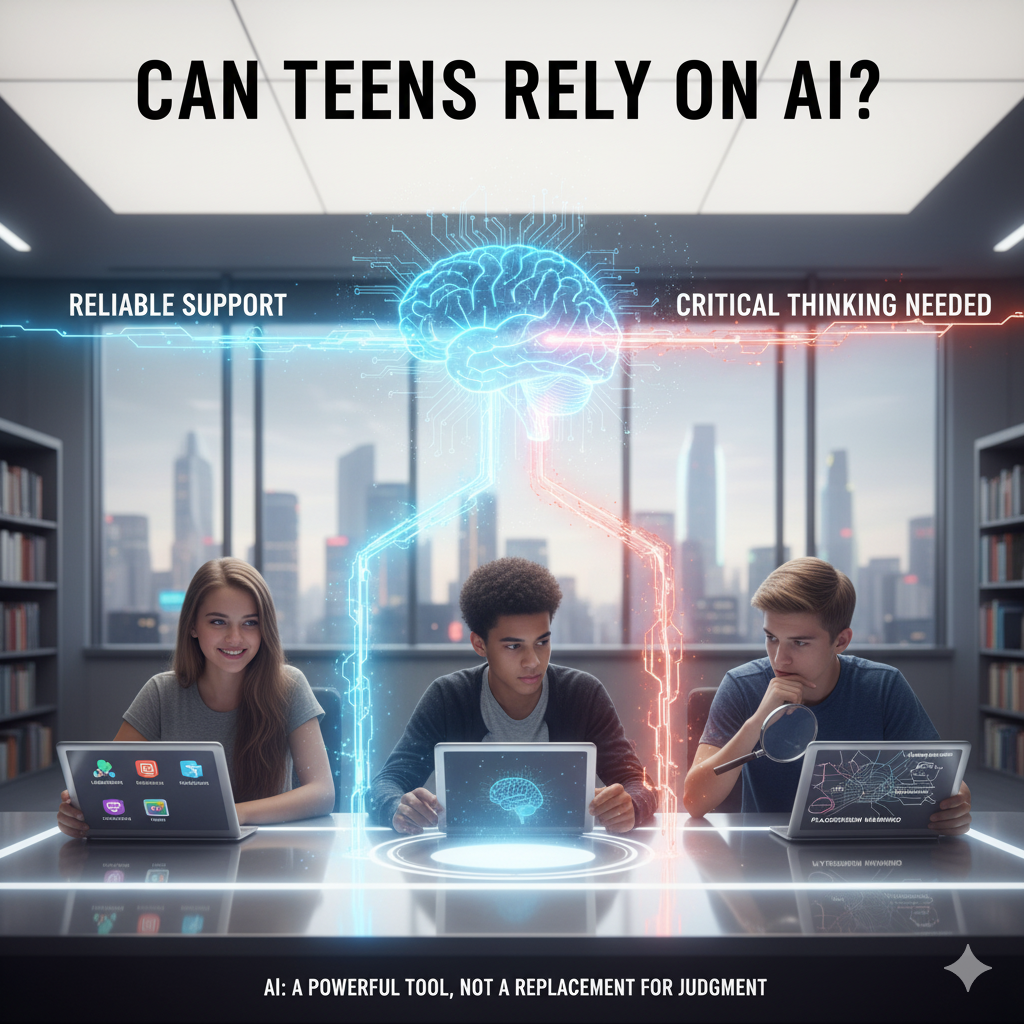
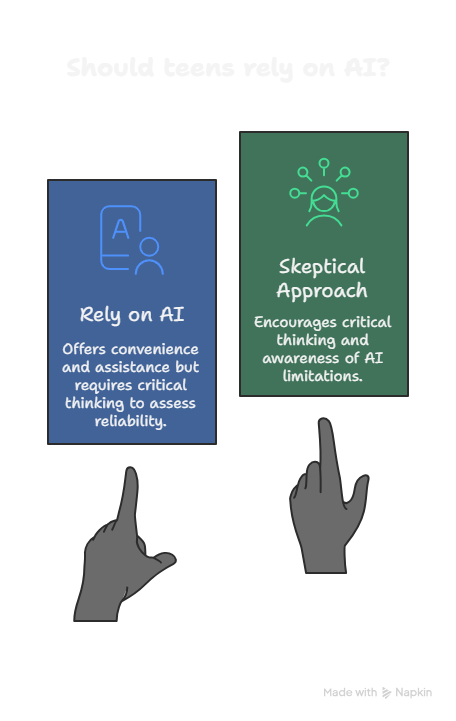
AI is constantly improving, but it will never be perfect. Teens can rely on AI as a support tool, but not as the sole authority. The future belongs to those who can use AI thoughtfully, combining its power with human judgment, creativity, and empathy.
The goal is not blind trust, but informed reliance—where AI helps but doesn’t control.
🔮 Explore More Free Numerology & Astrology Tools
Free calculators and guides — no sign-up required
🧭
Life Path Number Calculator
Find the number that shapes your entire life journey from your date of birth
👼
Angel Number Calculator
Discover your personal angel number by birth date or name
🎨
Lucky Color Calculator
Find your zodiac sign's lucky colour by date of birth
✨
Angel Numbers Guide
What repeating numbers like 444, 1111 and 222 mean for you right now
📚
Numerology Hub
All guides, calculators and explainers in one place
FAQs
Q1. Can teens fully trust AI?
No, teens should use AI as a helpful guide but not as an unquestionable authority. AI can make mistakes, show bias, or provide incomplete answers.
Q2. What are the biggest dangers of AI for teens?
Privacy risks, misinformation, bias, and over-reliance are key dangers. Responsible use helps avoid these issues.
Q3. How can teens protect themselves while using AI?
They can avoid sharing personal data, fact-check AI responses, and limit screen time to protect mental balance.
Q4. Should parents let teens use AI freely
Supervision is important. As teens rely on AI more for learning and creativity, parents shouldn’t ban it—but guide them toward safe, ethical, and balanced use instead.
Q5. Can AI affect teen mental health?
Yes, excessive use can cause dependency or reduce real-world interactions. However, mindful use can actually support well-being through learning and productivity.
Q6. Is it okay for teens to use AI chatbots for emotional support?
Occasionally talking through feelings with an AI chatbot isn’t inherently harmful, but it shouldn’t become a replacement for real relationships or professional support when needed. If AI conversation starts consistently replacing reaching out to friends, family, or a counselor, that’s a sign to intentionally reconnect with real people rather than relying on AI as an emotional substitute.
💰 WEALTH & MONEY CALCULATORS
Discover Your Financial Luck & Money Energy
Final Thoughts: Can Teens Rely on AI?
AI is an amazing resource for teens, but relying on it blindly is risky. By understanding bias, protecting privacy, and maintaining mental balance, young users can ensure AI works for them, not against them.
The digital age calls for awareness and responsibility. Teens who learn to balance AI use with real-life skills will not only adapt to the future—they’ll shape it. Teens need to become 10X AI Leaders for the Future—individuals who use AI wisely, lead with ethics, and harness innovation to create meaningful change.