Artificial Intelligence has moved from science fiction into the school bag. Today’s teenagers use AI every single day, to write, to study, to make music, to get homework help, to explore careers they didn’t know existed five years ago. Most of them are doing it without a roadmap.
This guide is that roadmap. Whether you are a parent trying to understand what your teenager is actually doing with AI, or a teen figuring out how to use it without getting into trouble academically or personally, this page covers everything. It brings together the best information on AI tools, safety, mental health, academic integrity, careers, and creative opportunities so you don’t have to search for each piece separately.
Every section links to a full in-depth guide on that specific topic. Start here, then go deeper on the areas that matter most to you.
Why AI Literacy Is One of the Most Important Skills Teens Can Build Right Now
AI literacy — understanding what AI is, how it works, how to use it well, and where it fails — is becoming as foundational as reading and maths. Employers in almost every field are beginning to list it as a requirement, not a bonus. Universities are factoring it into admissions conversations. And schools are scrambling to keep up with how fast the technology is changing.
Teens who develop a genuine understanding of AI now — not just as users but as critical thinkers about what it can and cannot do — will enter adulthood with a serious advantage. Those who use it passively, without understanding it, risk the opposite: dependency on a tool they can’t evaluate or explain.
The good news is that learning to use AI responsibly is not complicated. It starts with a few core principles that apply across every tool, every situation, and every age group.
- Use AI to understand things, not to avoid understanding them.
- Always verify AI outputs before trusting them — especially for facts, dates, or data.
- Protect your personal information: never share details with an AI tool you wouldn’t share with a stranger.
- Be honest about how you use AI, especially at school — policies are tightening fast.
- Balance digital use with real-world relationships, hobbies, and offline time.
These principles sound simple, but applying them consistently is where the real skill develops. The sections below show exactly how they play out in the specific areas of a teenager’s life.
🎓 Planning What Comes Next?
AI skills, careers, side hustles, and smart choices for using AI wisely — everything to get a head start.
AI and Teen Responsibility: Making Smart Choices Every Day
The question is not whether teens will use AI — they already are. The question is whether they will use it in ways that help them grow, or in ways that quietly hold them back.
Using AI responsibly as a teenager means asking yourself three questions before every interaction:
- Am I using this AI to help me think, or to avoid thinking?
- Am I being honest with my school, my parents, and myself about how I’m using it?
- Would I be comfortable if someone I respected could see exactly what I just asked and what I’m doing with the answer?
Those three questions cut through almost every ethical grey area teens encounter with AI. The answers guide better decisions faster than any rulebook.
The responsibility conversation goes deeper than just homework. It covers privacy, creativity, emotional dependency, and the kind of person you’re becoming as a digital citizen. Our full guide on AI and Teen Responsibility: Benefits, Risks and Smart Choices covers all of this in detail, including how parents can have this conversation without it becoming a lecture.
The Best AI Tools for Teens in 2026 — And How to Use Each One Well
There are hundreds of AI tools available to teenagers right now. Most of them fall into a handful of categories, and knowing which category you’re dealing with helps you use the tool better and avoid its pitfalls.
AI Study and Homework Helpers
ChatGPT, Claude, Gemini, and similar conversational AI tools are the most widely used by students. Used well — to explain concepts, generate practice questions, check reasoning, or explore ideas — they are genuinely powerful study partners. Used badly — to generate essays or answers submitted as your own — they create short-term convenience and long-term problems.
The best approach: always write your first draft yourself, then use AI to improve it, explain what you don’t understand, or check your logic. This way you do the thinking and the AI helps you refine it.
AI Creative Tools
Image generators like DALL-E and Midjourney, music tools like Suno, and writing assistants like Sudowrite let teens create things that would have required professional skills a decade ago. These tools are genuinely exciting for creative teenagers. The responsibility here is about originality — using AI as a starting point and adding your own creative judgment, rather than publishing AI outputs as purely your own work.
For a detailed look at how teens are already using AI creatively in school settings, see creative ways teens are using AI in school.
AI Productivity and Organisation Tools
Notion AI, Reclaim, and similar tools help with time management, note organisation, and planning. These are among the lowest-risk applications of AI for teens and often the most immediately useful for managing the demands of school, extracurriculars, and a social life simultaneously.
For a detailed breakdown of which tools work best for which situations, our guides on 7 Proven AI Tools Teens Can Use to Study Smarter and Unlock Your Learning Potential with These 5 AI Tools in 2026 go through each option with specific use cases and honest assessments of where they fall short.
AI and Academic Integrity: Where the Line Is
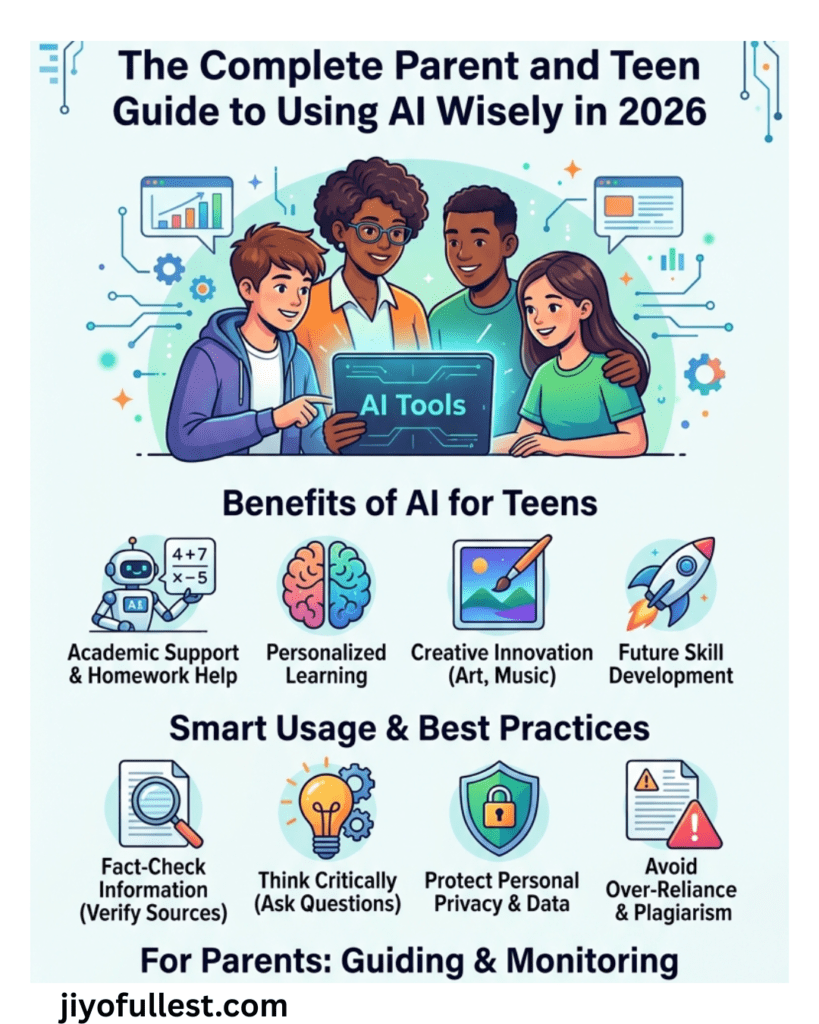
The single most pressing concern for students using AI right now is the academic integrity question. Schools and universities around the world are drawing lines — and those lines are in different places depending on the institution.
The core issue is straightforward: AI can produce the output of learning without the learning itself happening. An essay generated entirely by AI gives you the essay. It does not give you the thinking, the research skills, the argument structure, or the writing ability that the essay was designed to develop. Those compound over years. Outsourcing them at 15 creates a gap that shows up painfully at 25.
A practical framework for teens:
- Did I use AI to understand the material, or to avoid engaging with it?
- Could I explain this work out loud if a teacher asked me to walk through it?
- Have I checked my school’s AI policy — and disclosed my AI use where required?
- Is the final work genuinely mine, even if AI helped me improve it?
Most schools now have specific AI policies. When in doubt, ask your teacher directly. The question itself demonstrates exactly the kind of ethical awareness that responsible AI use requires — and teachers notice that.
The students who will thrive in an AI-integrated world are not the ones who use it most — they are the ones who use it most thoughtfully. That distinction starts forming now
😌 Bored, Stressed, or Just Need Ideas?
Hobbies, books, group activities, and real ways to handle teenage stress — for when school feels like a lot.
AI and Teen Mental Health: What Parents and Teens Both Need to Know
This is the part of the AI conversation that gets the least attention and deserves the most.
AI companions and chatbots are increasingly popular with teenagers — particularly those who feel anxious, isolated, or socially uncertain. The appeal is obvious: an AI conversation involves no judgment, no awkwardness, no rejection. For teens who find human interaction exhausting or frightening, this can feel like relief.
The concern is not that these tools exist — it is that they can meet a social need just enough to reduce the motivation to develop real social skills and real human relationships. Emotional dependency on an AI interaction, in place of human connection, is a genuine risk for vulnerable teenagers.
Signs that AI use may be affecting a teen’s mental health include:
- Preferring AI chatbot conversations to time with friends or family.
- Distress or strong irritability when access to AI tools is removed.
- Withdrawal from hobbies or offline activities that were previously enjoyed.
- Using AI to process emotions instead of talking to trusted people.
None of these signals mean AI use should be banned. They mean it is time for an honest conversation. For parents, curiosity works far better than suspicion in starting that conversation.
Our guide on Can Teens Rely on AI? A Guide to Bias, Safety, and Mental Balance covers this in full, including how to talk about it, what healthy AI use looks like for different teen personalities, and when to consider professional support. If screen time and digital overload are affecting sleep or mood, our guide on free mental health apps also covers tools designed to support wellbeing rather than add to screen pressure.
AI Careers for Teens: The Opportunities Being Created Right Now
One of the most genuinely exciting things about the current AI moment is the range of real opportunities it is creating for young people — including teenagers who are willing to learn early.
The most valuable thing to understand is that AI careers are not just for programmers. The technology is being applied across every industry, and the roles it is creating require a wide range of skills: communication, creative judgment, ethics, project management, data analysis, and domain expertise in fields like healthcare, law, education, and design.
High-growth AI career areas accessible to motivated teens:
- Prompt engineering and AI content — creating, testing, and refining AI outputs professionally.
- AI ethics and policy — ensuring AI systems are fair, transparent, and safe.
- Data annotation and training — helping AI systems learn to recognise patterns correctly.
- AI-assisted creative industries — design, music, video, and writing with AI tools.
- AI in education — tutoring platforms, adaptive learning tools, and curriculum design.
- Entrepreneurship — building products and services on top of AI platforms.
For a detailed look at which careers are growing fastest and how teens can start building relevant skills today, see our guides on Top 10 AI-Powered Careers Teens Should Start Exploring Today and How AI is Shaping the Future Job Market. For teens who want to turn AI skills into real income now, our guide on AI Internships and Online Programs for Teens covers where to find opportunities, what they involve, and how to stand out as an applicant
AI and Teen Creativity: Making Something That Is Actually Yours
One of the most common concerns about AI and teenagers is the creativity question: if AI can generate art, music, writing, and video, does that mean young people will stop developing creative skills?
The answer depends entirely on how they use it.
AI used as a creative shortcut generates an image, posts it, and is done, producing nothing of lasting value for the creator. It bypasses the struggle, the iteration, the failure, and the discovery that are what actually develop creative ability over time.
AI used as a creative collaborator — generate a starting point, interrogate it, discard most of it, take one element in a direction the AI never anticipated, and combine it with your own ideas- can genuinely accelerate creative development in ways that were not possible five years ago. The best young creators working with AI today are using it to explore faster, iterate more, and access technical execution that used to require years of training. Then they apply their own voice, judgment, and vision to shape the output into something genuinely original.
The distinction matters enormously for both teenagers and parents. Our guide on AI and Teen Creativity: Can Technology Make You a Better Content Creator? explores this in detail, including practical examples of how teens are using AI in music, art, writing, and storytelling in genuinely creative ways
A Parent's Guide to AI and Teens: What You Actually Need to Know
Most parents know their teenager is using AI. Most feel underprepared to have a useful conversation about it. This section is specifically for parents who want to understand enough to guide — not ban, not micromanage, but genuinely guide — their teenager’s relationship with these tools.
What teens are actually using AI for:
- Homework help — summarising, explaining, checking, and in some cases writing.
- Creative projects — art, music, stories, videos, social media content.
- Social and emotional support — AI companions, journaling tools, mental wellness apps.
- Entertainment — AI games, personalised recommendations, interactive experiences.
- Research and curiosity — exploring ideas and questions without judgment.
Questions worth asking your teen — without making it an interrogation:
- What AI tools do you actually use? What do you use them for?
- Has your school told you anything about AI policies?
- Have you ever felt like you learned less because AI did it for you?
- Do you ever feel like you would rather talk to an app than to a person?
These conversations work best when they are genuinely curious rather than investigative. Teens who feel interrogated shut down. Teens who feel their parents are genuinely trying to understand stay open.
The goal is not to know everything your teenager does with AI. It is to build enough shared understanding that your teenager comes to you with the questions that actually matter — the ethical grey areas, the academic pressure, the moments when they are not sure what the right thing to do is.
📱 5 Free App Guides for Your Mind & Mood
No paywalls, no trials that quietly start charging you — just genuinely free tools, hand-picked and reviewed.
🧠 Not sure how stressed you actually are? Find out in 3 minutes.
Check My Stress Level →AI and Entrepreneurship: How Teens Are Building Real Things Right Now
Perhaps the most underreported story about AI and teenagers is how many of them are using it to build actual businesses. The barrier to entry for starting a technology-enabled business has dropped dramatically. A motivated sixteen-year-old with a clear idea and access to AI tools can now build, test, and launch a product that would have required a development team five years ago.
This is not hypothetical. Teens are currently building AI-powered tutoring services, content creation agencies, productivity apps, Etsy stores with AI-generated designs, social media management services for local businesses, and newsletter businesses in specialist niches.
The skills this builds, product thinking, customer understanding, financial basics, marketing, and iteration, are among the most valuable any young person can develop, regardless of whether the business succeeds.
Our guide on AI-Powered Dreams: How Teens Are Redefining Entrepreneurship covers specific examples, starting points, and the mindset shifts that separate teens who actually build things from those who only think about it.
Frequently Asked Questions
Is it cheating to use AI for schoolwork?
It depends on what you use it for and what your school’s policy says. Using AI to understand a concept, check your grammar, or brainstorm ideas is generally acceptable and often encouraged. Using AI to write your essay and submitting it as your own work crosses the line at most schools — and more importantly, it means you miss the actual learning the assignment was designed to provide. When in doubt, disclose your AI use to your teacher and ask. The question itself demonstrates good judgment.
What AI tools are safe for teenagers?
Most major AI tools — ChatGPT, Claude, Gemini, Canva AI, Grammarly — are widely used by teenagers and are generally safe in terms of content and privacy for standard tasks. The main safety consideration is not the tools themselves but what information you share with them. Never enter real personal details, private photos, or sensitive information into any AI tool. Treat it as a public space, not a private one.
How much AI use is too much for a teenager?
The signal to watch for is not time — it is dependency. If a teen cannot start a task without AI, cannot have a conversation they feel was meaningful without having processed it through a chatbot first, or feels significant distress when access is removed, those are signs the balance has shifted in the wrong direction. Healthy AI use enhances what the person can do. Unhealthy AI use replaces what the person would otherwise be developing.
Will AI replace the careers teens are studying for?
Some specific roles will change significantly. Many others will be augmented, meaning the job changes rather than disappears. The careers most at risk are those involving highly repetitive, predictable tasks. The careers most resilient to AI are those requiring human judgment, creativity, emotional intelligence, and physical presence. The best preparation for any teenager right now is to develop both AI literacy and the human skills AI cannot replicate — clear communication, critical thinking, empathy, and the ability to build relationships.
How do I talk to my teenager about AI without it becoming a conflict?
Lead with curiosity rather than concern. Ask what they are using, what they find useful, and what they find strange about it. Share your own questions and uncertainties. The goal of the first conversation is not to set rules; it is to establish that this is a topic you can talk about together.
Where to Go From Here
AI is not going away. The teenagers who engage with it thoughtfully — understanding what it is, how to use it well, and where its limits are — will be better prepared for school, for work, and for life than those who either avoid it entirely or use it without thinking.
This guide is a starting point. Use the links throughout to go deeper on the areas that matter most to your situation right now.
If you are a teen, start with AI and Teen Responsibility and 7 Proven AI Tools to Study Smarter.
If you are a parent, start with the Can Teens Rely on AI guide and the mental health section above.
If you are thinking about future careers, our guide on Top 10 AI-Powered Careers for Teens is the best place to start.
The digital age is already here. The question now is how well-equipped your teenager is to navigate it on their own terms.
🎓 Planning What Comes Next?
AI skills, careers, side hustles, and smart choices for using AI wisely — everything to get a head start.
Recent Posts
- Aquarius Zodiac Sign: Personality, Love, Career & Compatibility
- Pisces Zodiac Sign: Personality, Love, Career & Compatibility
- Libra Zodiac Sign: Personality, Love, Career & Compatibility
- Capricorn Zodiac Sign: Personality, Love & Compatibility
- Taurus Zodiac Sign: Personality, Love, Career & Compatibility