
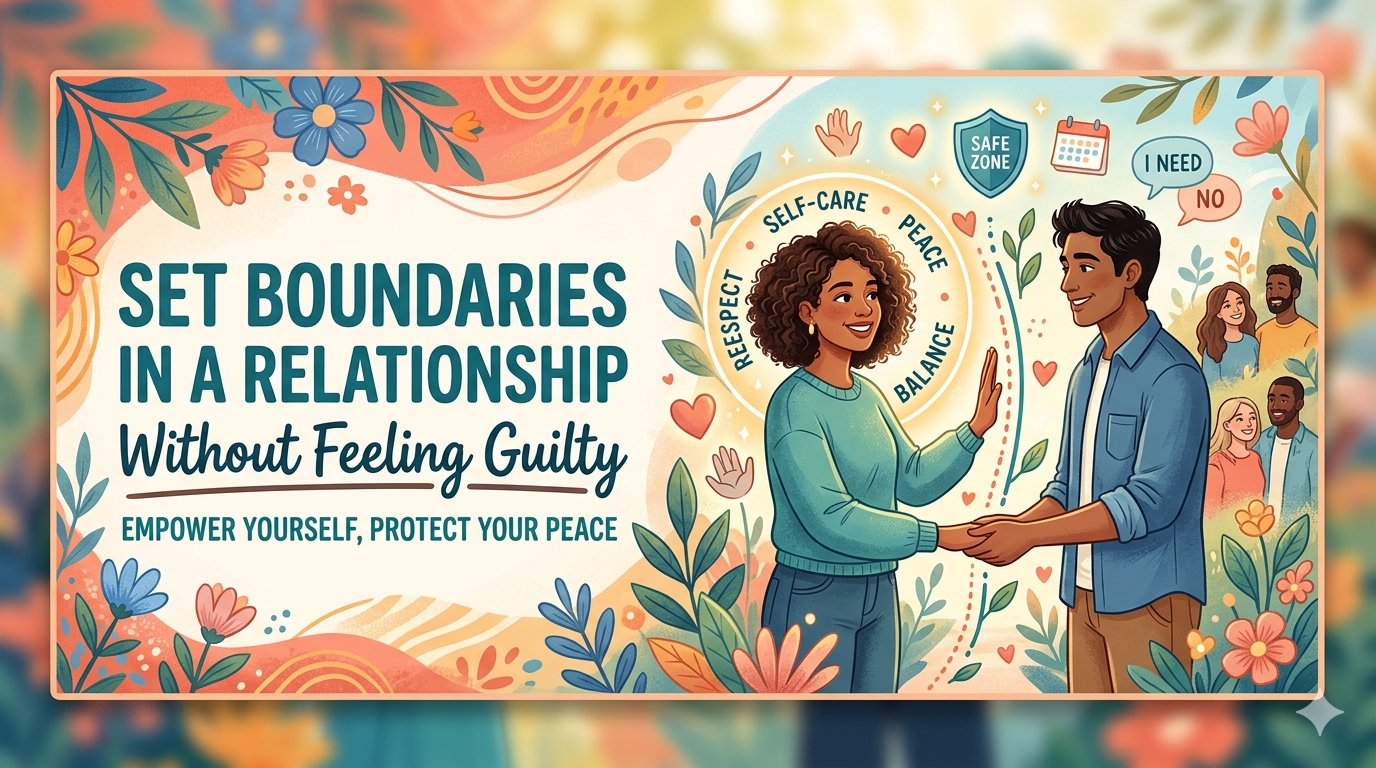
What Does It Mean to Set Boundaries in a Relationship?
Setting boundaries in a relationship means being honest and consistent about what you will and will not participate in — emotionally, physically, with your time, and in communication. Boundaries are not walls or ultimatums. They are the clear, kind expression of your genuine needs and limits, communicated so that both people know what is true about where you stand. Healthy boundaries allow both people to show up authentically without one person consistently suppressing their needs to accommodate the other.
You have been lying awake running the conversation through your head. You know what you need to say. You know, rationally, that what you are asking for is reasonable. And yet the moment you imagine actually saying it — the moment you picture their face, the silence, the possibility that they will be hurt or angry or disappointed — you back down before you have even opened your mouth.
So you say yes when you mean no. You show up when you are exhausted. You absorb what is not yours to carry. And somewhere in the gap between what you agreed to and what you actually needed, a quiet resentment begins to grow — directed partly at them and mostly at yourself.
This is what living without boundaries in a relationship actually feels like. Not dramatic. Not obviously toxic. Just a slow, consistent erosion of yourself in the service of keeping the peace.
Setting the boundary is not the hard part. Not feeling guilty about it is.
This guide is about that second part — the part most advice skips entirely.
💙 Do you get Anxious easily? Read these helpful guides
Measure how stressed you really are — free PSS-10 assessment, 3 minutes, no sign-up.
What Are Boundaries in a Relationship?
Boundaries are the agreements you make — with others and with yourself — about what you are and are not available for. They are not walls. They are not ultimatums. They are the honest communication of your needs, your limits, and the conditions under which you can show up as your genuine, healthiest self.
In relationships, boundaries typically fall across four dimensions.
Emotional boundaries are about how much of your emotional energy you give and what you take responsibility for. You can care deeply about someone’s feelings without being responsible for managing them. The line between empathy and emotional overresponsibility is something healthy boundaries clarify.
Physical boundaries cover personal space, physical touch, and the comfort level you have with different types of contact. In romantic relationships, these are often the clearest. In family relationships, they are often the most violated without either party naming what is happening.
Time boundaries are about how you allocate your time and what you protect it from. Consistently overcommitting your time in relationships is one of the most common forms of boundary absence — and one of the most direct routes to burnout and resentment.
Communication boundaries define the tone, timing, and manner in which you are willing to be spoken to and engage with difficult topics. Allowing conversations that become hostile, manipulative, or relentlessly one-sided without naming what is happening is a communication boundary that needs addressing.
Healthy boundaries are not about controlling what the other person does. They are about being clear about what you will and will not participate in — and taking responsibility for your own actions and needs rather than endlessly managing everyone else’s.
🌙 Your Moon Sign Explains a Lot About This
Everything above lives in your emotional world, and your Moon Sign is the closest thing astrology has to a map of exactly that: what genuinely soothes you, what sets you off, and what you actually need to feel secure. It takes two minutes to find yours.
Find My Moon Sign →Why Do You Feel Guilty Setting Boundaries?
Why Do I Feel Guilty When I Set Boundaries?
Guilt after setting a boundary is almost always a conditioned response, not a moral signal. Most people who struggle with boundary guilt were taught — explicitly or implicitly — that prioritising their own needs is selfish, that love means self-sacrifice, or that keeping others comfortable is their responsibility. The guilt is the nervous system's alarm that you have deviated from a familiar pattern. It is not evidence that you did something wrong. It is evidence that you are doing something new.
This is the question most boundary advice skips — and it is the most important one. If you understand where the guilt comes from, you can stop letting it make your decisions for you.
You were taught to prioritise others. For many people, particularly those raised in family environments where keeping the peace was the highest value, the needs of others were consistently and explicitly placed above their own. The lesson absorbed was: your needs are less important. Your comfort matters less. Putting yourself first is selfish. This lesson is not true. But it runs deep, and it is why boundary-setting feels viscerally wrong even when it is rationally correct.
You are afraid of rejection or conflict. The fear underneath most boundary guilt is not actually guilt — it is fear. Fear that the other person will withdraw, get angry, think less of you, or leave. Boundaries feel dangerous because, in some earlier relational context, they genuinely were. The nervous system does not easily update those old threat assessments, even when the current relationship is safe enough to handle honesty.
People pleasing has become your default operating mode. People pleasing is not a personality type. It is a learned survival strategy — developed in environments where making others comfortable was the most reliable way to feel safe and accepted. It served a purpose once. In adult relationships, it tends to produce the exhaustion, resentment, and loss of self that bring people to therapy.
Low self-worth is running the calculation. When you do not genuinely believe your needs are as valid as the other person’s, the guilt of prioritising yourself is almost automatic. The work of setting boundaries and the work of rebuilding self-worth are, in this sense, the same work.
Signs You Need Better Boundaries in Your Relationship
These are the internal experiences that consistently signal a boundary deficit — not dramatic betrayals, but the quiet daily accumulation of an unmet need.
- You feel drained after spending time with a particular person, even when nothing obviously difficult happened
- You say yes when you want to say no, then feel resentment about the yes
- You find yourself over-explaining, over-apologising, or pre-emptively justifying reasonable requests
- You feel responsible for managing the other person’s emotional reactions to things that are not your fault
- You avoid bringing up your real needs because the anticipated conflict feels worse than the ongoing suppression
- You feel relief when plans get cancelled, because the prospect of time alone feels like breathing again
- You regularly feel unseen, unheard, or like a supporting character in a relationship where you should be an equal protagonist
If more than three of these feel genuinely familiar, the issue is not that you are asking for too much. The issue is that you have been asking for too little — and telling yourself that is virtue.
🌿Do you get stressed easily? Read these helpful guides
Not sure how stressed you actually are? Take the free PSS-10 test — 10 questions, instant score.
🧠 Check My Stress Level →How to Set Boundaries Without Feeling Guilty — A Step-by-Step Framework
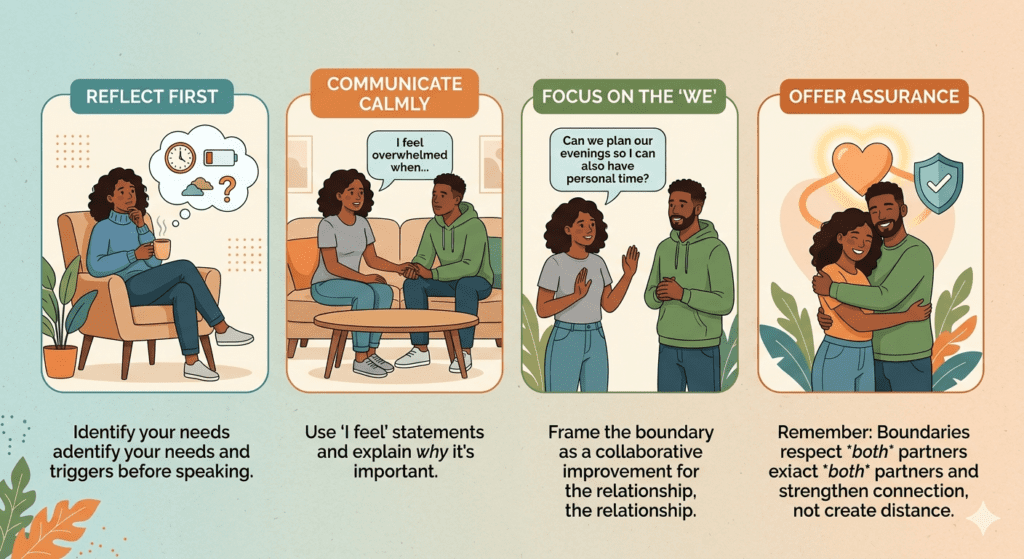
Step 1: Identify the actual need before the conversation. Before you can communicate a boundary, you need to be clear with yourself about what you actually need — not what you think you should need, not what would create the least conflict, but what is genuinely true. Journaling, talking with a trusted friend, or working with a therapist or relationship counsellor can help you distinguish between a genuine need and a habitual self-silencing. If you are experiencing persistent emotional distress in your relationship, professional counselling support gives you a structured space to do this work without the pressure of the relationship’s dynamic.
Step 2: Name the boundary in terms of your own behaviour, not theirs. The most effective boundaries are expressed as what you will do, not as demands about what the other person must do. This is not a technicality — it is the difference between a boundary and an attempt at control. “I need to leave at 10pm” is a boundary. “You need to stop keeping me out late” is a demand that may or may not be honoured.
Step 3: Say it clearly, without over-explaining. One of the most common mistakes in boundary communication is treating the boundary like it requires a comprehensive justification. It does not. You are allowed to have needs that do not require elaborate defence. A clear, warm, firm statement is usually more effective than a lengthy explanation — and significantly less likely to invite negotiation.
 Weak: “I mean, I kind of think maybe I might need a bit more space sometimes, if that’s okay.”
 Strong: “I need some time to myself this evening. I’ll reach out tomorrow.”
Weak: “I’m not sure, I’ll try to make it work somehow.”
Strong: “I’m not available for that, but I’d love to connect next week.”
Weak: “I feel bad saying this but I’m kind of overwhelmed.”
Strong: “I’m at capacity right now. I need the rest of this week to recover.”
Step 4: Allow the discomfort without interpreting it as wrongness. The guilt that arrives after setting a boundary is almost always the nervous system’s old alarm — the conditioned response that says “you have done something dangerous.” It is not evidence that you were wrong. It is evidence that you are doing something new. Sitting with that discomfort rather than immediately walking the boundary back is the practice.
Step 5: Reinforce the boundary consistently. A boundary communicated once and then abandoned teaches the other person that the boundary is negotiable. Consistency is not aggression — it is clarity. It tells the other person what is actually true about where you stand, which is ultimately a gift to both of you.
More on Relationships & Emotional Healing
If this resonated, these guides go deeper into the patterns, signs, and steps forward.

Scripts You Can Use Right Now
These are ready to use — adapted to your own voice and circumstances.
When you need to decline without lengthy justification: “I’m not going to be able to do that. Thank you for thinking of me.” “That doesn’t work for me. I hope you find a good solution.” “I care about you, but I can’t take that on right now.”
When you need time and space: “I need some time to myself today. I’ll reach out when I’m ready.” “I’m not in a place to have this conversation right now. Can we talk tomorrow?” “I need a few days to recharge. This isn’t about us — it’s about what I need.”
When a previous yes needs to become a no: “I said I could do that, but I’ve realised I’m not able to. I’m sorry for the change.” “I overcommitted. I need to withdraw from this one.”
When physical or emotional comfort is being crossed: “I’m not comfortable with that. Please stop.” “That kind of comment is something I won’t engage with. Let’s change the subject or take a break.”
When someone pushes back on a boundary: “I understand you feel that way. My answer is still no.” “I hear that you’re frustrated. The boundary stands.”
How to Handle Pushback When You Set a Boundary
What Do You Say When Someone Pushes Back on Your Boundary?
When someone pushes back on a boundary, the most effective response is calm, brief, and consistent. You do not owe anyone an escalating series of new justifications for the same boundary. A short, neutral statement works best: "I understand you feel that way. My answer is still no." or "I hear that you're frustrated. The boundary stands." Repeat it calmly as many times as needed without adding new explanations. Over-explaining invites negotiation. Calm consistency communicates that the boundary is real.
Not everyone will respond graciously when you establish a new boundary — particularly in relationships where the previous dynamic depended on your compliance. Here is what to expect and how to handle it.
Guilt-tripping is one of the most common responses. It usually sounds like: “I can’t believe you would do this to me” or “After everything I’ve done for you.” The guilt-trip works by framing your self-respect as an act of cruelty. It is not. Your need for a boundary did not create the guilt-trip. The other person’s unwillingness to respect it did.
Emotional escalation — raised voices, tears, extended silence — is designed to make maintaining the boundary feel more costly than abandoning it. The key is to remain calm and to avoid the trap of escalating in return or collapsing to restore emotional peace. A short, neutral acknowledgment works: “I can see you’re upset. I’m going to give us both some time.”
Persistent negotiation involves repeatedly returning to the same request, reframing it slightly each time, hoping to find an angle that breaks through. The response is the same each time: “I’ve heard you. My answer hasn’t changed.” You do not owe anyone an escalating series of new justifications for the same boundary.
If you are experiencing emotional manipulation or guilt-tripping as a consistent pattern in your relationship, working with a couples therapist or relationship counsellor can provide the tools and the supported space to address that dynamic directly. Persistent boundary violations are one of the most common presenting issues in relationship counselling, and professional mental health support is often what creates the breakthrough that repeated conversations alone cannot.
How Boundaries Actually Improve Relationships
Counterintuitively, relationships with clearly held and honestly communicated boundaries are more intimate, not less. Here is why.
They build genuine respect. When both people are honest about their needs and limits, the agreements between them are real rather than performed. You know the yes is genuine because you have seen the no.
They eliminate the resentment that erodes connection. Most relationship resentment is not the product of dramatic betrayal — it is the slow accumulation of small yeses that should have been nos, never named, never addressed, steadily building into a generalised bitterness that the other person often does not understand and cannot address because no one ever said what the actual problem was.
They improve communication at every level. People who are comfortable maintaining boundaries are also more comfortable expressing appreciation, vulnerability, and genuine affection — because they know the relationship can hold honesty in both directions.
They model healthy self-care for your partner. A relationship where one person consistently suppresses their needs does not just harm that person. It creates a dynamic where the other person is deprived of genuine feedback, genuine partnership, and the particular kind of growth that only comes from relating to someone who will not endlessly accommodate you.
Setting boundaries is one piece of a larger emotional wellbeing practice. These connected guides cover the patterns that make boundaries hard, the anxiety that comes when you do not have them, and the self-worth work that makes them stick.
Common Mistakes That Undermine Boundaries
Over-explaining converts a boundary into a negotiation. The more you explain, the more material you give someone to argue with. State the boundary once. Invite questions if appropriate. Resist the impulse to justify it into acceptance.
Apologising for the boundary itself signals that it is provisional. “I’m so sorry, I hate to ask this, but I think maybe I kind of need…” teaches the other person that the boundary comes with enough guilt attached that it can be worn down.
Setting the boundary but not enforcing it is perhaps the most corrosive mistake of all — because it teaches everyone, including yourself, that your stated limits are not real. Every unenforced boundary makes the next one harder to take seriously.
Expecting the boundary to be received warmly. Healthy boundaries are worth setting regardless of how they are received. Your needs do not require applause to be valid.
The Emotional Reframe That Changes Everything
Here is the thing no one tells people pleasers: guilt does not mean you are doing something wrong. It means you are doing something new.
The guilt you feel when you set a boundary in a relationship where you have never had one is not moral information. It is the nervous system’s alert that you have deviated from a familiar pattern — one that felt safe even when it was costing you. That alert is not a verdict. It is a signal that you are changing, and change feels like danger until it feels like freedom.
The people who have the most successfully boundaried relationships are not people who never feel guilt. They are people who have learned to feel the guilt, name it accurately, and take the action anyway — understanding that the discomfort of growth and the discomfort of wrongdoing can feel identical from the inside, and that distinguishing them requires self-knowledge rather than self-punishment.
Guilt is the tax on becoming a person who takes their own needs seriously. It is worth paying.
If you are struggling with persistent guilt, chronic people pleasing, or a pattern of self-erasure in relationships that feels beyond what these strategies can address, working with a therapist who specialises in emotional boundaries, self-worth, and relationship patterns can provide the structured support that turns awareness into genuine, lasting change. Therapy and counselling are not for crises only — they are for exactly the kind of deep, patient work that untangles the patterns that are costing you in your most important relationships.
From calming anxiety to finding your angel number — everything here is free, practical, and written to actually help.
Frequently Asked Questions
How do you set boundaries in a relationship without conflict?
Boundaries do not require conflict — they require clarity. The most effective approach is to set them calmly, in a non-reactive moment rather than in the middle of a difficult situation, using language that speaks to your own needs rather than criticising the other person’s behaviour. Conflict is most likely to arise not from the boundary itself but from how it is communicated — or from a relationship dynamic where any expression of your needs is treated as an act of aggression, which is itself important information about the relationship.
What does it mean to set boundaries?
Setting boundaries means being honest and consistent about what you will and will not participate in within a relationship. It is the practice of communicating your genuine needs, limits, and expectations rather than suppressing them in the interest of avoiding discomfort. Boundaries are not rules you impose on other people — they are honest statements about your own behaviour and the conditions under which you are able to show up well.
What is a boundary in a relationship?
A boundary in a relationship is an honest agreement — often implicit, sometimes explicit — about what is acceptable and what is not in terms of emotional, physical, time, and communication dynamics. Healthy boundaries allow both people to maintain their individuality, express their genuine needs, and trust that the relationship can hold honesty rather than requiring the performance of perpetual accommodation.
How do you overcome guilt in a relationship?
Overcoming guilt in relationships begins with understanding where the guilt comes from. For most people, relationship guilt is a learned response rooted in childhood messages about self-suppression, fear of conflict, or the equation of love with self-sacrifice. Distinguishing between healthy guilt (which signals a genuine moral error) and conditioned guilt (which signals a departure from a familiar pattern) is the central skill. Therapy, journaling, and developing genuine self-awareness about your own needs and values all support this process over time.
Why does setting boundaries feel selfish?
It feels selfish because, for many people, it was explicitly taught to be. Families and social environments that prioritised harmony over honesty, or that modelled self-sacrifice as the definition of love, produce adults who experience their own needs as impositions. The feeling of selfishness is real. The conclusion it leads to — that you should continue suppressing your needs — is not. Taking your own wellbeing seriously is the foundation of every healthy relationship you will ever have, including the one with yourself.
What if I feel guilty about something I said or did?
There is a meaningful difference between guilt about a genuine mistake and guilt about an appropriate assertion of your own needs. Genuine guilt — the kind that signals that you have acted against your values — deserves acknowledgment, apology where appropriate, and the commitment to behave differently. But the chronic guilt that accompanies boundary-setting in people-pleasers is usually not this kind of guilt. It is the nervous system’s alarm, not a moral verdict. Learning to tell the difference is one of the most important forms of emotional intelligence you can develop..
📱 5 Free App Guides for Your Mind & Mood
No paywalls, no trials that quietly start charging you — just genuinely free tools, hand-picked and reviewed.
🧠 Not sure how stressed you actually are? Find out in 3 minutes.
Check My Stress Level →Final Thoughts
Boundaries are not the wall between you and intimacy. They are the door that makes real intimacy possible — the one that opens from the inside because you chose to open it, not because you could not find a way to keep it locked.
The relationship you want — one where you feel seen, respected, genuinely cared for, and not perpetually exhausted by the effort of managing someone else’s comfort — that relationship requires you to be honest about who you are and what you need. It requires the risk of being known rather than the safety of being accommodating.
That risk is the boundary. And you are allowed to take it.
For deeper support with people pleasing patterns, emotional boundaries, and self-worth in relationships, our guides on how to stop worrying about things you can’t control, managing stress and emotional overwhelm, and improving your emotional strength and self-awareness offer the connected tools that make the boundary work sustainable rather than just occasional.
Recent Posts
- How to Build a Writing Portfolio as a Teen With No Experience
- Best Skincare Routine for a Natural Glow (Morning & Night)
- Hair Glow Up: Grow Healthier Hair From the Inside Out
- Digital Mental Health: A Complete, Evidence-Based Guide to Apps, Therapeutics, and Telehealth
- How Teens Can Start Freelance Writing With No Experience