

Quick Answer: How to Stop Worrying
To stop worrying, first ask whether the worry is something you can act on now. If it is, make one small plan and schedule it. If it is not, move it into a short daily worry window and bring your attention back to what you can do. Calm your body first with slow breathing or a grounding exercise, because a body in alarm keeps the worry loop running. Telling yourself to simply stop does not work and often backfires, so the methods below focus on redirecting worry instead. Need relief right now? Jump to the 2-minute reset.
You already know, on some level, that worrying about it will not change it. You know that the outcome of the conversation, the decision your boss makes, the way someone feels about you, the health result you are waiting for — none of these will be altered by the amount of mental energy you spend rehearsing worst-case scenarios at 2am.
You know this. And you do it anyway.
This is not a failure of willpower or rationality. It is the way the anxious mind works — and understanding that mechanism is the first step toward genuinely changing it, rather than simply trying harder to think your way out of a pattern that is not primarily a thinking problem.
Worrying about things you cannot control is one of the most common and most draining forms of anxiety there is. It is also one of the most socially accepted — we often mistake it for conscientiousness, for caring deeply, for being responsible. But there is a meaningful difference between genuine problem-solving and the circular rehearsal of scenarios you cannot influence, and only one of those two things is actually useful.
This guide gives you a practical, honest approach to letting go of what you cannot control — not through toxic positivity or the pretence that hard things are not hard, but through a set of concrete mental shifts and daily practices that actually interrupt the worry loop and redirect your attention toward the only territory where real influence is possible: yourself.
How to Stop Worrying Right Now: A 2-Minute Reset
If you are in the middle of a worry spiral, you do not need theory yet. You need something quick that interrupts it. Try these four steps in order. Together they take about two minutes.
Step 1: Breathe out slowly. Breathe in through your nose for about four seconds, then breathe out through your mouth for about six to eight seconds. A long exhale signals your body that it is safe to slow down. Do this five times.
Step 2: Ground yourself with the 3-3-3 rule. Name three things you can see, three sounds you can hear, and move three parts of your body, such as your fingers, shoulders and ankles. This pulls your attention out of your head and into the room.
Step 3: Name the worry in one sentence. Say it plainly, such as “I am worried that I will fail the presentation.” Putting it into words makes it smaller and more specific than the fog it was a moment ago.
Step 4: Pick one next action. Ask, “Is there one small thing I can do in the next hour about this?” If yes, do it or schedule it. If no, tell yourself, “Not now, this belongs in my worry window,” and move to the next task.
That is not a cure, but it is often enough to bring the intensity down so you can think. For more physical techniques you can use in under five minutes, see our guide on how to calm anxiety fast.
✨ No Sponsorships. No Fluff.
The Free Self-Care Apps Actually Worth Keeping on Your Phone
Why Do We Worry About Things We Can't Control?
Before you can stop doing something, it helps to understand why you are doing it — because the reason is not irrational, even if the behaviour is ultimately counterproductive.
Worry is a cognitive attempt at control. When your mind perceives a threat — a situation that feels uncertain, high-stakes, or potentially painful — it responds by trying to prepare for every possible outcome. Mentally rehearsing the worst-case scenario feels like preparation. It feels like if you can just think through every possibility thoroughly enough, you will somehow be better equipped to handle whatever happens. The mind treats thinking about a problem as though it is equivalent to doing something about it.
The problem is that for things genuinely outside your control, this preparation loop has no off-switch. There is no thought thorough enough, no scenario rehearsed enough times, no mental preparation complete enough to satisfy the anxious mind’s need for certainty — because the certainty it is seeking does not exist. So the loop continues, consuming enormous mental energy while producing nothing of practical value.
There is also a neurological dimension. The amygdala — the brain’s threat-detection system — cannot easily distinguish between a real danger and an imagined future danger. It responds to both with the same activation, the same cortisol release, the same sustained alertness. When you worry about something that has not happened, your nervous system experiences it as though it is happening now. This is why chronic worry is genuinely exhausting — you are putting your nervous system through an experience repeatedly without it ever resolving.
Understanding this mechanism matters because it tells you something important: the solution to worry is not more thinking. It is redirection — learning to notice when the thought loop is circling something outside your control and deliberately, consistently moving your attention toward what is inside it.
One of the most reliably timed worry cycles is Sunday evening anticipatory anxiety — the dread that arrives before the week has even started. Our Sunday scaries guide covers the eight specific techniques that interrupt this weekly cycle at the point where it is most addressable.
💙 Do you get Anxious easily? Read these helpful guides
Measure how stressed you really are — free PSS-10 assessment, 3 minutes, no sign-up.
🧠 Take the Stress Test →The One Distinction That Changes Everything
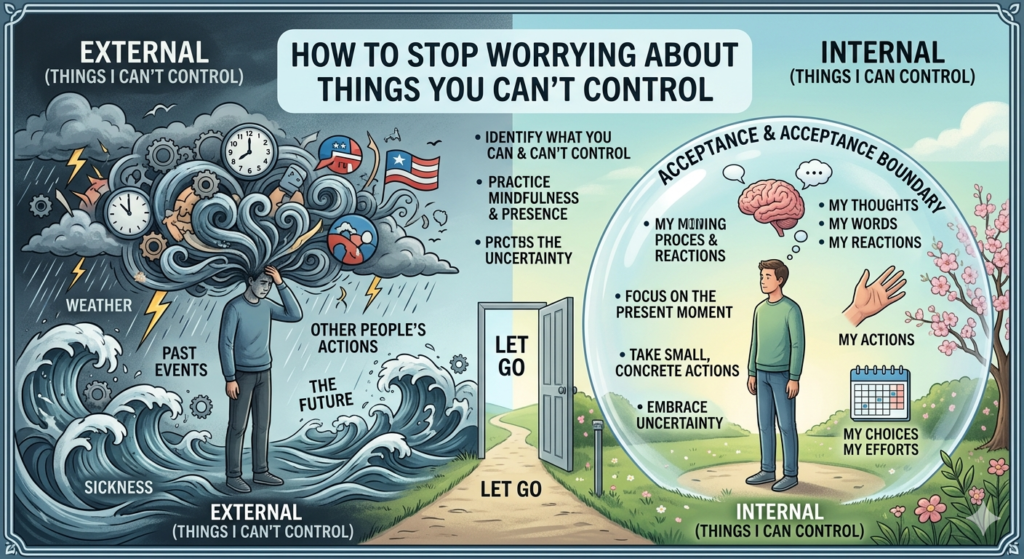
The single most useful mental framework for stopping worry about uncontrollable things is the distinction between your circle of concern and your circle of influence — a concept popularised by Stephen Covey but rooted in the Stoic philosophy that has guided people through genuine hardship for over two thousand years.
Your circle of concern contains everything you care about — everything that matters to you and therefore has the capacity to cause you anxiety when it feels uncertain or threatened. Other people’s opinions. Economic conditions. Health outcomes. Whether the relationship works out. What your manager decides. How a difficult conversation goes.
Your circle of influence contains only what you can actually affect — your choices, your responses, your preparation, your communication, your effort, your boundaries, your attention.
The anxious mind spends most of its time in the circle of concern. The result is a persistent sense of powerlessness and exhaustion — you are pouring energy into territory you cannot move, which means you simultaneously feel overwhelmed by everything and effective at nothing.
The practice is to notice when your attention is in the concern circle and ask a specific question: is there anything in my influence circle that is relevant to this situation? If yes, do that thing. If no, the worry is pure expenditure — you are paying a real cost for zero return.
This is not the same as not caring. You can care deeply about outcomes you cannot control. The question is whether caring about them requires spending your mental and emotional resources in ways that do not serve either you or the situation.

What Research Says About Worry
Most of what we worry about never happens. In a 2020 study published in the journal Behavior Therapy, researchers Lucas LaFreniere and Michelle Newman asked people with generalized anxiety disorder to write down their worries over ten days and then checked what actually happened. About 91 percent of the worries did not come true, and in many of the cases where they did, the outcome was easier to handle than expected. The point is not that your worries are silly. It is that the mind is much better at predicting danger than at predicting how well you will cope.
Research on thought suppression explains why simply telling yourself to stop worrying fails. In a well-known 1987 study, psychologist Daniel Wegner asked people not to think about a white bear, and found that they thought about it more than people who were free to think about it. The same effect applies to worry: pushing the thought away tends to make it return louder. This is why the better approach is to redirect your attention, set the worry aside for later, or deal with the problem behind it.
The scheduled worry window you will see below also has research behind it. In a 1983 study, Thomas Borkovec and colleagues taught chronic worriers to limit their worrying to one set time and place each day, and found that this reduced how much they worried overall. Many CBT therapists still use this technique today.
How to Identify What Is Actually In Your Control
One of the reasons worry about uncontrollable things persists is that the boundary between what is and is not within your control is not always obvious. We often conflate influence with control, or mistake partial influence for full control.
A useful exercise is to take the specific thing you are worrying about and break it into components. For each component, ask: can I directly determine the outcome of this, or can I only influence the probability?
For example: you cannot control whether you get the job. You can control the quality of your preparation, the authenticity of your presence in the interview, and how you follow up. You cannot control your partner’s feelings about a situation. You can control how honestly and kindly you communicate your own. You cannot control a health diagnosis. You can control whether you attend appointments, follow medical guidance, and take care of your baseline wellbeing.
The components in your influence column are where your attention and energy belong. The components in the no-influence column are where worry lives — and the honest acknowledgement that they genuinely sit outside your control is not resignation. It is the accurate map that tells you where your effort can and cannot produce results.
When the worrying about uncontrollable things is most intense — when it is spiralling at night or intruding during otherwise peaceful moments — this is often a sign that your nervous system is asking for care rather than more thinking. Our guide on how to stop overthinking at night covers the specific techniques that interrupt the night-time worry loop, which tends to be particularly persistent because the absence of daytime distractions removes the mental activity that keeps it at bay during waking hours.
🌿Do you get stressed easily? Read these helpful guides
Not sure how stressed you actually are? Take the free PSS-10 test — 10 questions, instant score.
🧠 Check My Stress Level →5 Practical Techniques to Stop the Worry Loop
1. The worry window
Rather than trying to eliminate worry entirely — which tends to produce the opposite of its intended effect, because what you resist persists — schedule it. Choose a specific 15-minute period each day as your designated worry time. When a worry about something outside your control arises outside of that window, acknowledge it without engaging: “I see you, I will come back to you at 4pm.” Then return to what you were doing.
When the scheduled window arrives, worry actively and thoroughly about the things on your list. Write them down. Examine them. Then close the notebook and do something else.
This technique works because it honours the mind’s impulse to process rather than suppressing it, while containing that processing to a period where it is intentional rather than intrusive. Most people who try it find that the worries feel significantly less urgent when they arrive at the scheduled time — the act of postponing them has already reduced their emotional charge.
2. The “what would I do if” shift
When you catch yourself worrying about a specific worst-case outcome, instead of trying to reassure yourself that it will not happen, ask: what would I do if it did?
This shift moves you from passive dread — imagining the bad thing happening with no agency — to active problem-solving, which engages the prefrontal cortex rather than the amygdala. You are not pretending the bad thing will not happen. You are discovering that even if it did, you would have options, resources, and the capacity to respond.
Most people who go through this process with their genuine fears find that the worst case, while genuinely hard, is significantly more survivable than the ambient dread had led them to believe. The fear of the thing is almost always worse than a clear-eyed examination of the thing itself.
3. The 10-year question
Ask yourself: will this matter in ten years? Not as a dismissal of real concerns but as a perspective calibrator. Many things that produce acute worry — the social interaction that went awkwardly, the email that was misread, the plan that changed at the last minute — have no presence at all in a ten-year view.
For the things that do matter in a ten-year view, this question does not eliminate the concern. But it re-contextualises it in a way that tends to reduce the acute anxiety, because a concern that genuinely matters over a long time horizon also genuinely deserves a response proportional to its actual importance — not the panicked over-response that acute anxiety produces.
4. Name the story, not just the feeling
When you notice yourself in a worry loop, try to name the specific narrative your mind is running rather than just the emotional experience of it. Not “I feel anxious” but “I am telling myself that if my partner seems distant it means they are losing interest in me and the relationship is ending.” Not “I am stressed about work” but “I am telling myself that if I make a mistake on this project my manager will see me as incompetent and my position will become precarious.”
Named precisely, most worry narratives reveal themselves as stories built from specific assumptions — assumptions that can be examined, questioned, and often found to be significantly less certain than the emotional intensity around them suggested.
5. Physical interruption before cognitive reframing
One of the most important and consistently overlooked aspects of interrupting worry is that the body needs to discharge the physiological activation before the mind can genuinely shift its narrative. Trying to think your way out of a worry spiral while your nervous system is still in a heightened state is like trying to read in a car that is driving over rough ground — the condition does not support the task.
Before attempting any of the cognitive techniques above, use a physical interruption first. Two minutes of slow breathing with extended exhales. Cold water on your wrists. Five minutes of movement. This is not a detour — it is the prerequisite that makes the cognitive work actually effective.
Our guide on how to calm anxiety fast covers 10 specific techniques for the physical side of anxiety interruption — the ones that work in under five minutes and do not require any equipment or preparation.
10 More Ways to Stop Worrying (Techniques 6 to 15)
The five techniques above are the foundation. These ten add more tools, so you can pick the ones that fit your kind of worry. You do not need to use them all. Try two or three this week and keep the ones that work.
6. Use the Worry Tree
The worry tree is a simple decision flow used in CBT. First, name the worry. Then ask, “Is this something I can do something about?” If yes, ask whether you can act now. If you can, do it. If you cannot, plan exactly when you will, then let it go until then. If the answer to the first question is no, the tree says to let the worry go, redirect your attention to something that absorbs you, and come back to it only if the situation changes.
For example, “I am worried about my exam results” splits into “I can study for the next paper” (act, schedule it) and “I cannot change the marks already given” (let go). Try it on your biggest worry tonight, on paper, and notice how much of the worry falls into the “let go” branch.
7. Use Dale Carnegie’s Worst-Case Formula
In his classic 1948 book How to Stop Worrying and Start Living, Dale Carnegie describes a three-step method he credits to an engineer named Willis Carrier. First, ask yourself what is the worst that can happen. Second, prepare to accept it if you have to. Third, calmly try to improve on the worst case. The idea is that vague dread feels enormous, while a specific worst case can be faced, planned for and usually survived.
For example, if you are afraid of losing your job, the worst case may be a few months of searching for work. Once you see it clearly, you can build a backup plan, such as updating your resume and saving a little each week, and the dread loses much of its force. Carnegie also recommended living in “day-tight compartments,” which means focusing on getting through today instead of carrying the whole future at once.
8. Keep a Worry Outcomes Log
Write down each significant worry and the date, then come back to it a week or two later and note what actually happened. Over time, you build your own evidence about how reliable your worries are. Most people find that a large majority of them never happen, just as the research above suggests.
Use a notes app or a small notebook. Add a column for “how I coped,” because that is often the most useful part. When a new worry appears, you can look at your own record instead of arguing with the feeling.
9. Turn “What If” Into “What Then”
Worry lives in “what if” questions, which have no end. “What if I fail? What if they say no? What if it goes wrong?” Try finishing the thought with “what then?” What would you do next, who could you ask for help, and how have you handled something like this before? This is sometimes called decatastrophizing, and it moves your mind from endless possibilities to one realistic plan.
Write three “what if” questions that are bothering you, and write a one-sentence answer to “what then?” for each. The answers do not need to be perfect. They just need to prove to your mind that you would have options.
10. Do Not Fight the Thought, Notice It
Because pushing worry away backfires, try observing it instead. Say to yourself, “I am having the thought that something will go wrong,” and then let it pass like a cloud while you continue what you were doing. Therapists who use metacognitive therapy teach people to notice worry as a mental event and not to follow it or argue with it. The less attention you give a worry, the less it feeds on itself.
Practice this for just one minute at a time. Watch the thought arrive, and gently return to what is in front of you, such as the task, the conversation or your breath.
11. Practice Tolerating Uncertainty
Researchers such as Michel Dugas have found that a major driver of chronic worry is difficulty tolerating uncertainty. The mind tries to solve every unknown in advance, which cannot be done. You can train this gently by choosing small, safe uncertainties on purpose, such as trying a new route home, ordering something you have not tried or making a small decision without researching it.
Each time you allow a small unknown to stay unresolved and nothing bad happens, you teach your mind that it can cope. Try one this week.
12. Cut Down on Worry Fuel
Some habits quietly feed worry. Constant news and social media scrolling keep your mind scanning for threats. Too much caffeine can make some people feel jittery and anxious. Poor sleep makes worries feel bigger and harder to manage. You do not have to cut everything out, but notice which of these makes your worry louder and turn it down for a week.
A simple start is a news check at set times instead of all day, and no scrolling in the last hour before bed. If worry is worst at night, our guide on how to stop overthinking at night goes deeper.
13. Move Your Body
Worry is energy with nowhere to go. A brisk walk, a workout, a bike ride or even ten minutes of stretching helps your body burn off the stress chemicals that keep your mind on alert. Regular physical activity is also widely recommended as part of managing anxious feelings over the long term.
Pick something you enjoy so you will actually do it, and use it as your first move when a worry spiral starts. A short walk outdoors often works better than staying in the same room with the same thoughts.
14. Do One Absorbing Thing
Your mind cannot fully focus on two demanding things at once. Choose an activity that takes real attention, such as a puzzle, cooking a new recipe, drawing, a hobby project or a game that needs concentration. When you are fully absorbed, worry loses its grip for a while, and you often return to the problem calmer.
If you are not sure what to try, our list of hobbies to pick up has plenty of ideas.
15. Talk It Through With Someone You Trust
Worry grows in silence. Saying it out loud to a friend, family member, mentor or counselor often shrinks it, because another person can point out what you are missing or simply remind you that you are not alone. You do not need advice. Sometimes it is enough to say, “I am worried about this, and I just want to say it.”
If worry is heavy, constant or hard to manage alone, talking to a professional is a strong step, not a weak one. See the section below on when worry becomes more than a habit.
What Acceptance Actually Means (and What It Doesn't)
One of the most misunderstood ideas in anxiety management is acceptance. It is frequently interpreted as passive resignation — as agreeing that the bad thing is fine, as giving up on trying to influence outcomes, as becoming indifferent to things that genuinely matter.
This is not what acceptance means in a therapeutic context, and the misunderstanding is one of the primary reasons people resist it.
Acceptance, in the context of worry about uncontrollable things, means acknowledging the reality of a situation as it actually is rather than as you wish it were. It does not mean you like it. It does not mean you agree with it. It does not mean you are not working toward change where change is possible. It means you are not investing energy in the resistance to what simply is — the mental and emotional effort of insisting that things should be different from how they currently are, which produces suffering without producing change.
The worry loop that torments people who cannot stop thinking about uncontrollable things is almost always, at its root, a form of resistance. The mind is insisting that the uncertain thing should be certain, that the outcome should already be known, that the uncomfortable waiting should be over. Acceptance interrupts that insistence — not by pretending the uncertainty does not exist, but by allowing it to exist without demanding that it resolve itself on the schedule the anxious mind is requiring.
This is a practice, not a decision. You do not decide to accept something and then experience permanent peace about it. You return to acceptance repeatedly, each time you notice the resistance loop activating again, and over time the resistance requires less force to interrupt and the peace that follows it becomes more accessible.
Relationships are one of the hardest areas where you must accept and let go of someone you love when you can’t control the outcome.
📱 5 Free App Guides for Your Mind & Mood
No paywalls, no trials that quietly start charging you — just genuinely free tools, hand-picked and reviewed.
🧠 Not sure how stressed you actually are? Find out in 3 minutes.
Check My Stress Level →How Morning Habits Reduce Your Baseline Worry
The degree to which worry about uncontrollable things dominates your mental life is not fixed. It varies — and one of the most significant variables is the baseline state of your nervous system when the worrying thoughts arrive.
A nervous system that begins the day in a regulated, calm state has significantly more capacity to hold uncertain situations without being destabilised by them. A nervous system that begins the day already activated — having checked news and notifications before getting out of bed, having rushed through a chaotic morning with no space between waking and being immediately demanded of — is far more easily tipped into the worry loop by the same circumstances.
This is why how you start your mornings has a disproportionate effect on how much of your day is spent worrying. Not because the morning routine changes the circumstances you are worrying about, but because it changes the state of the system that encounters them.
The specific morning practices that most reliably reduce baseline anxiety — and therefore reduce the intensity and frequency of worry loops across the whole day — are covered in our guide on morning routine ideas for anxiety. The key insight is that even 15 minutes of intentional morning structure reduces the nervous system’s baseline activation enough to make a measurable difference in how the rest of the day feels.
✨ The Complete Glow Up Guide
Skin, hair, and the habits behind both. Start with whichever part of your glow up matters most to you.
How to Stop Worrying About Specific Things
General techniques help, but some worries need slightly different handling. Here is how to apply the ideas above to the most common ones.
How to Stop Worrying About the Future
Future worry is the mind trying to protect you from problems that have not happened. A useful approach is to plan once and then stop. Pick the single most important thing you can do in the next 24 hours toward the future you want, write it down and do it. Then, when your mind jumps ahead, say, “I have planned what I can for now.” Carnegie’s idea of living in day-tight compartments applies here, because you can only act in today.
How to Stop Worrying About Your Health
If a symptom is bothering you, the most helpful step is to book an appointment with a doctor instead of searching online for hours. Searching symptoms tends to raise anxiety and rarely gives a clear answer. After the appointment, trust the information you receive, and limit yourself to checking in about it once, not many times a day. If worry about your health is frequent or makes it hard to function, mention that to your doctor too, because it is a recognized and treatable pattern.
How to Stop Worrying About Everything
When it feels like everything is a worry, the problem is usually volume, not any single issue. Do a worry dump: set a timer for ten minutes and write down every worry, big and small. Then sort them into three piles. Mark the ones you can act on today, the ones that need a plan for later, and the ones you cannot influence. Do the first pile, schedule the second, and give the third to your worry window. Seeing everything on paper often turns an overwhelming cloud into a short, manageable list.
How to Stop Worrying About Small Things
For small worries, shrink them with time. Ask, “Will this matter in ten days? In ten months? In ten years?” This is based on the 10-10-10 rule popularized by writer Suzy Welch. Most small worries lose their weight within a few seconds of asking, and what remains is usually easy to handle.
How to Stop Worrying About Someone You Love
Worrying about a partner, friend, parent or adult child can feel like an act of love, so letting go feels like neglect. It is not. Separate what is yours from what is theirs. You can offer support, say you are there if they want to talk and take care of your own part, but you cannot make their choices for them. If a conversation is needed, say it once, kindly and clearly, instead of replaying it in your head. Our guides on setting boundaries in a relationship and how to let go of someone you love can help with the harder cases.
When Worry Is a Signal Worth Listening To
Not all worry is noise. Sometimes persistent worry about a situation you cannot control is your deeper self’s way of communicating something that deserves conscious attention — not the anxiety about the specific uncontrollable outcome, but the underlying need or value the anxiety is pointing toward.
If you are constantly worried about your relationship, the anxiety may be pointing toward a need for greater security or communication that is worth addressing directly. If you are perpetually anxious about your work performance, the worry may be pointing toward a misalignment between your current role and your genuine strengths that deserves honest examination. If health anxiety keeps returning despite reassurance, it may be pointing toward a relationship with mortality that has not yet been consciously explored.
In these cases, the goal is not to eliminate the worry but to follow it back to its actual source and engage with that source directly. A worry that points toward something real and addressable is not the enemy — it is a message. The enemy is the circular repetition of the worry without the willingness to look at what it is actually saying.
This distinction — between worry as noise and worry as signal — is one of the most useful things to develop in your relationship with anxiety. It requires the willingness to sit with the uncomfortable feeling long enough to ask what it is genuinely pointing toward, rather than immediately trying to make it stop.
If you find that persistent worry is producing the kind of exhaustion, low mood, and difficulty functioning that goes beyond occasional difficult days, that is worth taking seriously as a signal in itself. Our guide on signs you need a mental health day covers the specific indicators that your nervous system is asking for more than a technique — that it is asking for genuine rest, support, or a change in the conditions producing the stress.
A significant part of relationship anxiety is rooted in the absence of clear boundaries — the chronic worry about how someone will react to your needs, your limits, or your honest feelings. Our guide on how to set boundaries in a relationship without feeling guilty addresses that specific dynamic directly, including why the guilt feels inevitable and how to work through it.
Worry, Anxiety and Overthinking: What Is the Difference?
These words overlap, but they are not identical. Worry is mostly thoughts, usually about a specific problem or future event, such as “What if I do not get the job?” Anxiety includes worry but also involves the body, such as a racing heart, tense muscles or an unsettled stomach. Overthinking is the habit of going around the same thoughts over and over, often about the past as well as the future, without reaching a decision.
The difference matters because the tools differ a little. Worry responds well to action planning and the worry window. Anxiety often needs the body calmed first. Overthinking usually needs a decision, a deadline or a distraction to break the loop.
When Worry Is More Than a Habit
Everyone worries. For some people, worry becomes so constant that it affects daily life. Generalized anxiety disorder is generally described as excessive worry on more days than not for at least six months, along with symptoms such as restlessness, tiredness, trouble concentrating, irritability, muscle tension or sleep problems. It is common and highly treatable.
It may be worth speaking with a doctor or a licensed therapist if your worry feels uncontrollable, lasts for months, disrupts your sleep, work or relationships, or comes with physical symptoms that frighten you. Cognitive behavioral therapy has a strong track record for this, and so do some medications for those who need them. Asking for help is a practical step, not a sign of weakness.
If you are looking for support between appointments, our guides to the best mental health apps for anxiety and the best therapy apps are good starting points. If you ever feel unsafe or think about harming yourself, contact your local emergency number or a crisis line right away.
The Daily Practice That Makes the Difference
Every technique in this guide works. None of them work once, applied in isolation, on the hardest days, without practice.
The people who genuinely reduce their tendency to worry about uncontrollable things are not the ones who found the perfect insight or the most elegant reframe. They are the ones who practised the circle-of-influence distinction repeatedly until it became a reflexive filter for their attention. Who used the worry window consistently enough that their mind learned it had a scheduled outlet. Who returned to physical regulation before cognitive reframing enough times that it became the automatic first response rather than something to remember.
The practice does not need to be perfect or daily without exception. It needs to be consistent enough that the new patterns — noticing when you are outside your circle of influence, redirecting, regulating physically, naming the story — become more automatic than the default worry loop they are replacing.
This is slow work. It is also one of the highest-return investments available in everyday mental wellbeing — because the energy that is currently going into worrying about things that cannot be changed is genuinely available for redirection toward things that can be. And the life built from that redirected energy looks meaningfully different from the one that was spent in the worry loop

Books on How to Stop Worrying
If you like to read, two books come up again and again for this topic. How to Stop Worrying and Start Living by Dale Carnegie, first published in 1948, is a practical classic full of real stories and simple rules, including the worst-case formula and the idea of living in day-tight compartments. It is a good pick if you prefer short, story-driven advice.
For a more modern, therapy-based approach, many readers turn to workbooks built on cognitive behavioral therapy, which walk you through worry exercises step by step. If you try one, look for a title written or reviewed by a licensed clinician.
Frequently Asked Questions
Why can’t I stop worrying even when I know it’s irrational?
Because worry is not primarily a rational process — it is a nervous system response. Knowing intellectually that worrying will not change an outcome does not stop the worrying because the part of your brain driving the anxiety (the amygdala) does not respond to intellectual arguments. It responds to physical signals — breath, movement, physical regulation — and to repeated practice of redirecting attention. The techniques in this guide work not because they convince your mind logically but because they change the physiological and behavioural conditions that sustain the worry loop.
Is it possible to completely stop worrying about things I can’t control?
Complete elimination is not a realistic or necessary goal. The aim is not to become a person who never worries but to become a person whose worry is proportional, responsive rather than intrusive, and whose default attention moves toward what is within their influence rather than circling endlessly around what is not. Most people who work consistently with the practices in this guide find that worry decreases significantly in frequency and intensity, and that when it arises it feels more manageable and shorter-lived rather than all-consuming.
What is the fastest way to stop a worry spiral mid-moment?
Physical interruption first — two minutes of slow breathing with extended exhales, or cold water on the wrists, or five minutes of movement. Then the cognitive shift: identify specifically what you are worrying about, ask whether it is inside or outside your circle of influence, and if it is outside, ask what if anything in your influence circle is relevant to this situation. If nothing is relevant, the worry has no action attached to it and can be postponed to your scheduled worry window. The physical step is the prerequisite — trying to do the cognitive shift while the nervous system is still activated rarely works.
How do I stop worrying about a relationship when I can’t control how the other person feels?
Focus your attention on two things only: what you can honestly communicate about your own experience and needs, and what you can observe about whether this relationship genuinely supports your wellbeing. You cannot control another person’s feelings, choices, or level of commitment. You can control the quality of your own communication, the clarity of your own boundaries, and the honesty with which you evaluate whether what you are experiencing serves you. Worry about a relationship almost always grows in the gap between what you are avoiding communicating and what you need to say — and the most effective thing you can do for the anxiety is usually to have the honest conversation rather than rehearsing it indefinitely.
What is the 3-3-3 rule for anxiety?
The 3-3-3 rule is a quick grounding exercise. Name three things you can see, name three sounds you can hear, and move three parts of your body. It pulls your attention out of worried thoughts and back into the present moment, and it takes less than a minute.
How do I train my brain to stop worrying?
You train your brain through repetition. Use a daily worry window, sort worries into what you can and cannot act on, and practice returning your attention to the present each time worry appears. Keeping a worry outcomes log also helps, because it shows your brain that most worries do not come true. Expect gradual change over weeks, not overnight.
Should you tell yourself to stop worrying?
Not as a command. Research on thought suppression suggests that trying to force a thought away often makes it come back stronger. It works better to acknowledge the worry, decide whether you can act on it, and then redirect your attention or move it to your worry window.
What if you did not worry?
Many people believe worry protects them, so they fear that dropping it means being careless. In reality, worrying and planning are different. Planning leads to action, while worry repeats the same thoughts without solving anything. You can still prepare, care and take sensible precautions without carrying constant dread.
How do I stop worrying about everything?
Start with a worry dump. Write down every worry for ten minutes, then sort them into three groups: things you can act on today, things to plan for later and things you cannot influence. Act on the first group, schedule the second and give the third to your worry window. If everything stresses you out most days, speak with a doctor or therapist, because it may be a sign of anxiety, which is very treatable.
How do I stop worrying about the future?
Plan once, then stop. Choose the one most useful action you can take in the next 24 hours, do it, and tell yourself you have done what you can for now. When your mind jumps ahead, return to the present task. Focusing on one day at a time is easier than carrying the whole future.
How do I stop worrying about my adult children?
Separate what you can influence from what you cannot. You can offer support, stay available and look after your own wellbeing, but you cannot control their choices. Say your concern once and clearly, then trust them to handle their own lives. Having your own interests and friends also helps keep worry in proportion.
Is it normal to worry all the time?
Frequent worry is common, especially in stressful periods. If it lasts most days for six months or more, affects your sleep or daily life, or comes with physical symptoms such as constant tension, it is worth talking to a doctor or therapist. This is a common, treatable condition and help works.
From calming anxiety to finding your angel number — everything here is free, practical, and written to actually help.
Final Thoughts
Worry about uncontrollable things is not a character flaw. It is a very human response to living in a world that is genuinely uncertain, genuinely high-stakes, and genuinely unpredictable. The problem is not that you care deeply enough about your life to feel anxious about how it unfolds. The problem is when the caring redirects itself from the things you can actually affect into the endless rehearsal of things you cannot.
If worry about what other people think is at the heart of your stress, our guide on how to stop caring what people think pairs well with this one. And if you want to see how your stress levels measure up, you can try our stress level calculator.
The circle of influence is always smaller than we would like it to be. It is also always enough — enough to build something real, to communicate something true, to take care of the people and work and life that matter to you. The energy freed from the worry loop does not disappear. It becomes available for exactly that.
Remember that you do not have to do all fifteen techniques. Pick two or three, start with the 2-minute reset when you need relief, and use the worry window to keep the rest in its place. Worry is a very human response, and with practice it becomes quieter, shorter and easier to set down.
Recent Posts
- How to Build a Writing Portfolio as a Teen With No Experience
- Best Skincare Routine for a Natural Glow (Morning & Night)
- Hair Glow Up: Grow Healthier Hair From the Inside Out
- Digital Mental Health: A Complete, Evidence-Based Guide to Apps, Therapeutics, and Telehealth
- How Teens Can Start Freelance Writing With No Experience