
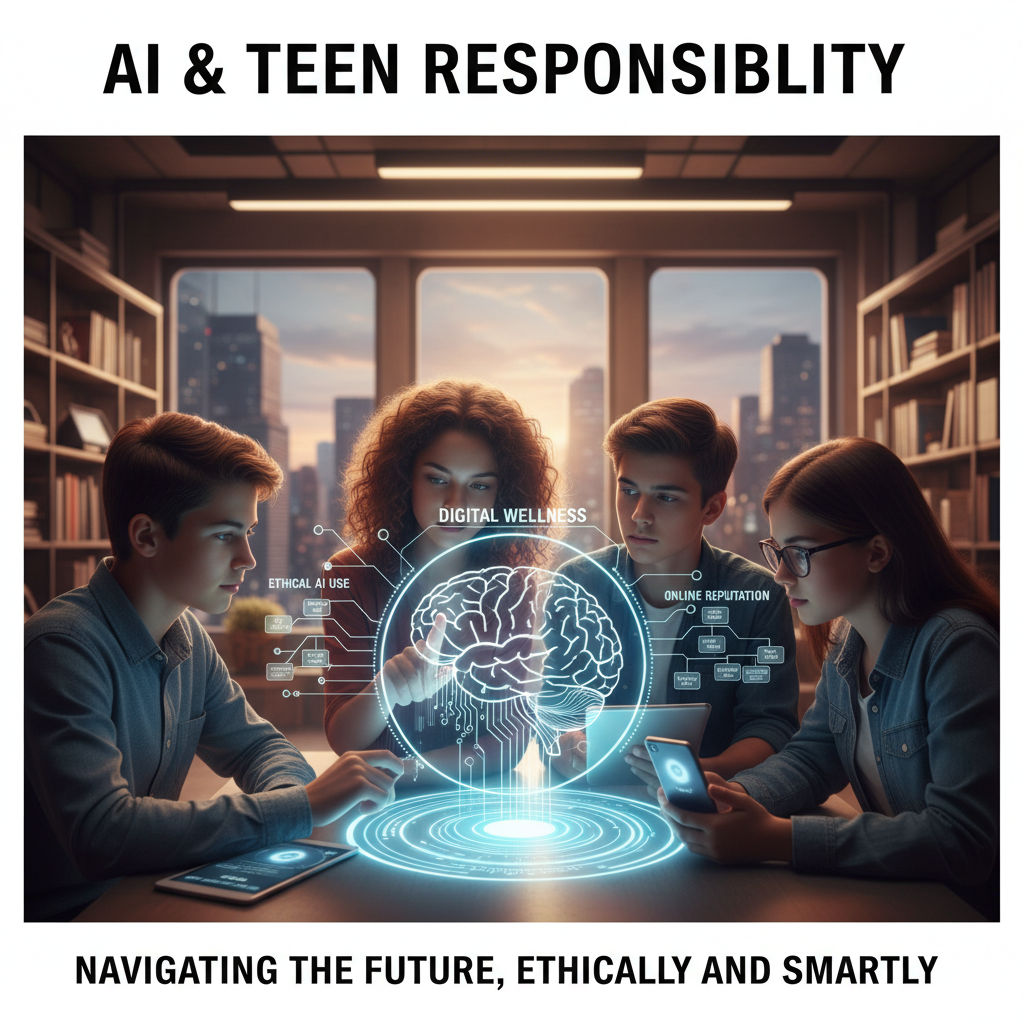
AI and Teen responsibility is no longer a futuristic concern—Artificial Intelligence (AI) is already part of everyday life. From personalized recommendations on YouTube and Netflix to AI-powered study apps and even creative tools for music and art, today’s teens are growing up in a world where AI plays a major role.
But with these opportunities come responsibilities. How teens use AI today will shape not only their personal growth but also the way technology evolves in the future. That’s why it’s so important to understand how to make smart, ethical, and responsible choices when using AI in the digital age.
This blog will explore how AI and Teen interactions can bring incredible benefits while also requiring mindfulness of risks, and how young people can strike the right balance between innovation and responsibility.
If you want the full picture across all areas of AI and teenage life, tools, safety, careers, mental health, and academic integrity, our complete guide to AI and teens covers everything in one place.
Table of Contents
ToggleWhy AI Matters for Teens
AI is like a double-edged sword—it can empower teens to learn faster, think more creatively, and explore new opportunities. At the same time, over-reliance on it or careless use can lead to problems like misinformation, lack of originality, or even privacy risks.
Here are a few key reasons why AI matters for today’s teens:
Education Support – AI study apps can summarize lessons, explain concepts, and help with homework.
Creativity Boost – Teens can use AI to write stories, generate art, or compose music.
Career Preparation – Knowing how AI works today gives teens a head start for future jobs.
Personal Growth – AI can provide insights into mental health, productivity, and self-improvement.
But just like with any powerful tool, the way it’s used makes all the difference.
Smart Choices Teens Can Make with AI
1. Use AI as a Learning Partner, Not a Shortcut
It’s tempting to let AI write essays or solve math problems instantly. But the smarter choice is to use AI as a study partner—ask it for explanations, practice problems, or examples rather than copying answers. This builds real understanding and prevents dependency.
2. Balance AI with Human Creativity
AI can generate poems, paintings, and even full songs. While that’s exciting, true creativity comes from combining human imagination with AI assistance. Teens should use AI for brainstorming or enhancing ideas rather than replacing their unique voice.
3. Be Aware of Privacy and Safety
Many AI tools collect data. Teens should avoid sharing personal details, sensitive photos, or private information. A simple rule is: if you wouldn’t tell a stranger, don’t tell an AI tool.
4. Fact-Check Everything
AI sometimes makes mistakes—it can confidently present false information. That’s why teens need to double-check answers with trusted sources like books, teachers, or verified websites before relying on AI responses.
5. Practice Digital Balance
Spending too much time on AI chatbots or games can reduce real-world social skills. Teens should balance digital use with hobbies, friendships, and family time.
If screen time and digital overload are affecting sleep or mood, our guide on how to stop overthinking at night has practical techniques specifically for when a busy digital day follows you into bed.
6. Think About Ethics
Using AI responsibly means asking questions like:
“Am I being honest?”
“Am I using AI in a way that benefits me without harming others?”
“Would I be proud if someone knew how I used AI?”
These small reflections help build a strong sense of digital ethics.
AI Tools Teens Are Actually Using — and What to Know About Each One
Talking about AI responsibility in the abstract is useful. But teens are already using specific tools every day, and understanding each one helps make smarter choices in practice rather than in theory.
ChatGPT and similar AI chatbots are the most widely used by teens for schoolwork, creative writing, and general questions. The key responsibility here is academic honesty — most schools now have clear policies about submitting AI-generated content as original work. Using ChatGPT to understand a concept, brainstorm ideas, or check your own writing is legitimate and genuinely useful. Copying a response and submitting it as your own work is not, and most teachers are now trained to spot the difference.
AI image generators like DALL-E and Midjourney allow teens to create visual art from text prompts. These tools raise interesting questions about creativity and originality. They also raise real concerns about misuse — generating realistic images of real people without their consent, creating misleading visual content, or producing images that are inappropriate. The rule of thumb is simple: if you wouldn’t be comfortable showing it to a parent or teacher, don’t generate it.
AI recommendation systems are the least visible but most influential AI teens interact with daily. Every time YouTube, TikTok, Spotify, or Instagram decides what to show you next, that is an AI making a decision based on your past behaviour. Understanding this helps teens become more intentional about what they engage with, because the algorithm is always learning from every click, pause, and replay.
AI writing assistants like Grammarly and QuillBot sit in a grey area academically, but are widely accepted as legitimate tools for improving your own writing. The responsible use is to write first and use AI to refine — not to generate and submit.
Knowing what these tools do, how they make decisions, and where the lines are makes a teen a more informed and responsible user, which is exactly what the digital age requires.
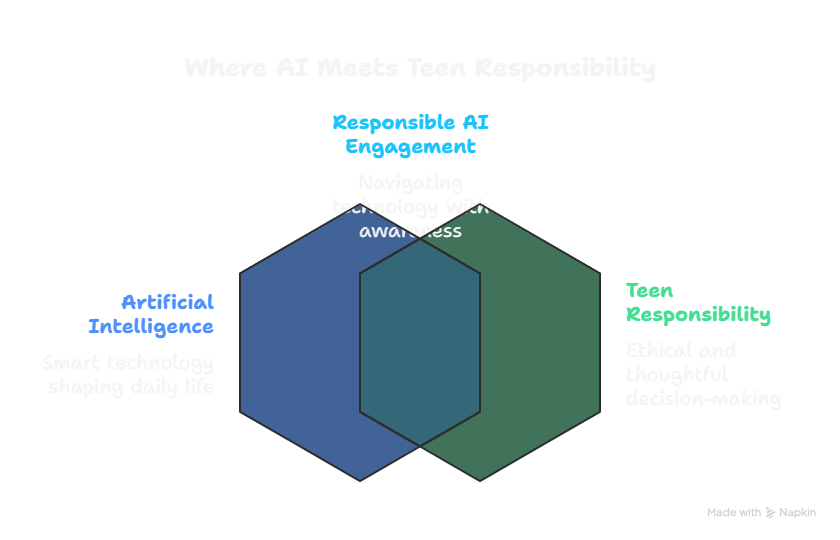
Responsible AI Use for Teens
As Artificial Intelligence becomes a common part of learning, creativity, and online tools, teens need to understand how to use it responsibly. Smart AI use helps teens benefit from technology while protecting their privacy, security, and critical thinking skills.
1. Understand What AI Can and Cannot Do
AI tools can analyze information, generate text, and provide suggestions, but they are not always accurate. Teens should treat AI as a support tool, not a replacement for their own thinking.
Tip: Always verify AI generated information using reliable sources.
2. Protect Personal Privacy
Many AI platforms collect data to improve their services. Teens should be careful about sharing personal information online.
Good practices
• Never share sensitive details like address, phone number, or passwords
• Review app privacy settings before using AI tools
• Prefer trusted platforms with strong data protection
Protecting personal data helps prevent identity theft and online security risks.
3. Be Aware of AI Bias
AI systems learn from human created data, which means their outputs may sometimes reflect biases.
Teens should question AI suggestions and avoid accepting them blindly. Comparing AI outputs with trusted sources helps ensure balanced understanding.
4. Practice Responsible Digital Behavior
Responsible AI use also means maintaining good digital etiquette.
Teens should avoid using AI to create harmful content, manipulate others, or spread misinformation. Respectful online behavior builds a positive digital reputation.
5. Use AI in Balance
AI tools can be engaging, but overusing them can reduce real world learning and social interaction.
Setting limits on AI usage and prioritizing learning, creativity, and skill building helps maintain a healthy balance.
6. Use AI Ethically for Creativity
Many teens use AI for writing, art, and creative projects. While these tools can be powerful, they should be used responsibly.
Teens should avoid plagiarism, respect copyright rules, and use AI to enhance creativity rather than replace personal effort.
7. Avoid AI Shortcuts
AI can generate answers quickly, but relying entirely on AI for assignments can limit learning.
Instead, teens should use AI to explore ideas, clarify concepts, and develop their own original work.
8. Develop Critical Thinking
The most important skill in the AI age is critical thinking. Teens should question AI outputs, compare multiple sources, and understand the reasoning behind information.
This ensures AI becomes a tool for learning and growth rather than dependency.
How Parents and Teachers Can Guide Teens
Teens don’t have to navigate this digital world alone. Parents and teachers play a vital role in shaping responsible AI use. Here are a few ways they can help:
Open Conversations – Instead of banning AI tools, discuss how they can be used responsibly.
Set Boundaries – Encourage balance by setting limits on screen time.
Model Behavior – Adults who use AI responsibly set an example for teens to follow.
Provide Resources – Introduce safe AI platforms for learning and creativity.
AI and Teen Mental Health — What Parents Need to Know
The mental health impact of AI use on teenagers is one of the most underresearched and underreported areas of digital parenting. Most conversations focus on screen time in general, but AI tools present a specific set of concerns that are worth understanding separately.
AI companions and chatbots, apps that simulate conversation or emotional support, are increasingly popular with teenagers, particularly those who feel socially isolated or anxious. While these tools can offer a low-pressure way to practise communication or process thoughts, there are legitimate concerns about teens forming emotional dependencies on AI interactions in place of real human relationships. The ease of an AI conversation — no judgment, always available, endlessly patient — can feel preferable to the messiness of real relationships, especially for teens already struggling socially.
AI recommendation algorithms are also worth understanding as a parent. The same systems that make YouTube and TikTok so engaging are designed to maximise watch time, not wellbeing. Teens who are anxious, lonely, or going through difficult periods are particularly vulnerable to recommendation loops that amplify negative emotions rather than helping them process and move on.
Practical steps parents can take right now:
Ask your teen which AI tools they use regularly and what they use them for — without making it an interrogation. Curiosity works better than suspicion.
Encourage your teen to notice how they feel after using specific apps. Do they feel energised and informed, or drained and anxious? Building this self-awareness early is one of the most valuable digital skills a young person can develop.
Make sure AI tools are supplementing real friendships and activities, not replacing them. Signs of concern include preferring AI conversation to human contact, emotional distress when access is removed, or withdrawal from offline activities they previously enjoyed.
If you notice your teen showing signs of anxiety, low mood, or social withdrawal that seems connected to their digital habits, it may be worth exploring what support is available. Our guide on free mental health apps includes tools specifically suited to younger users that can support emotional balance, alongside, not instead of, professional help if needed.
A practical framework for teens to apply when unsure:
The next generation will grow up side by side with AI. Future jobs, communication, and even healthcare will rely heavily on it. Teens who learn today to be responsible, ethical, and creative with AI will be better prepared for tomorrow.
Instead of being passive users, teens have the power to become leaders, innovators, and ethical voices in the AI revolution.
AI Safety Tools Every Teen Should Know
As AI tools become more popular, it is important for teens to use platforms that prioritize online safety and responsible AI usage. Many modern apps now include built-in safety filters, content moderation, and data protection features.
Parents and teens can also explore AI safety tools and digital monitoring apps that help track screen time, block harmful content, and promote responsible internet usage.
Some helpful categories include:
• Parental control software for monitoring online activity
• AI content filters that block inappropriate material
• Screen time management apps that encourage healthy digital habits
Using these tools helps create a safer environment for teens while allowing them to explore the benefits of AI responsibly.
Why Cybersecurity Awareness Matters for Teens Using AI
As teens interact with AI chatbots, writing assistants, and learning platforms, understanding basic cybersecurity practices becomes increasingly important.
Many AI tools process user inputs to improve their systems. Sharing personal details on these platforms can sometimes create data privacy and security risks.
Important cybersecurity habits include:
• Never enter personal details such as home address, phone numbers, or passwords into AI tools
• Using strong passwords and enabling two-factor authentication when available
• Avoiding suspicious AI apps or unknown websites
Building cybersecurity awareness early helps teens develop strong digital safety habits, which are essential in a world where AI and online platforms play a growing role in education and communication.
The Future of AI and Teen Responsibility
Did I use AI to understand something or to avoid understanding it? Using AI to explain a concept you then worked with yourself is learning. Using AI to produce a final answer you submit without engaging with is not.
Could I explain this work out loud if asked? If a teacher asked you to walk through your essay or your solution, could you do it confidently? If not, the work is not genuinely yours regardless of how much AI was involved.
Did I disclose my AI use where required? When in doubt, disclose. A note saying you used AI to help brainstorm or check grammar is far better than being caught having used it without acknowledgment.
Teens who develop a clear personal policy on AI and academic integrity now are building exactly the kind of ethical judgment that will serve them in every professional environment they enter — where these same questions about AI use, attribution, and originality are being debated at the highest levels.
AI and Academic Integrity — Where the Line Is
One of the most pressing conversations happening in schools right now is where responsible AI use ends and academic dishonesty begins. For teens, understanding this boundary is not just about avoiding trouble — it is about protecting the actual value of their education.
The core issue is this: AI can produce the output of learning without the learning itself happening. A student who uses AI to write an essay has the essay — but they do not have the thinking, the research, the argument-building, or the writing practice that the essay was designed to develop. Those skills compound over time. A student who outsources them at 15 will feel the gap at 25.
Most schools and universities now have AI use policies. Some ban AI-generated content entirely. Others allow it with disclosure. Many are still figuring out where they stand. Teens who are unclear should ask their teacher directly rather than assume. The question itself demonstrates the kind of ethical awareness that responsible AI use requires.
FAQs About AI and Teens Responsibility
Q1. Can teens use AI for schoolwork?
Yes, but it should be used as a helper, not a replacement. AI can explain concepts, create practice questions, or suggest ideas—but the actual learning should come from the teen.
Q2. What risks should teens watch out for when using AI?
Privacy issues, misinformation, over-reliance, and reduced creativity are the biggest risks. Being mindful helps avoid these pitfalls.
Q3. How can parents ensure their teens are using AI responsibly?
Parents can encourage open conversations, set healthy limits, and guide teens toward safe and educational AI platforms.
Q4. Will learning AI skills help teens in their careers?
Absolutely. AI literacy is already becoming a valuable skill in fields like technology, healthcare, finance, education, and entertainment. Teens who learn early gain a strong advantage.
Q5. Can AI affect mental health for teens?
Yes, if used excessively. Overuse can cause dependency or reduce real-life interactions. However, mindful use can actually support mental wellness through productivity apps, meditation tools, or journaling support. For a curated list of apps that actually support teen mental wellness without adding more screen time pressure, our guide to free mental health apps covers the best options available right now.
Final Thoughts- AI and Teens Go Hand in Hand
AI is here to stay, and for teens, it’s both an opportunity and a responsibility. By making smart choices—like using AI as a tool for growth, respecting privacy, and valuing human creativity—young users can shape a future where technology empowers, not controls, them.
The digital age calls for awareness, balance, and responsibility. Teens who understand this will not just survive in an AI-driven world—they’ll thrive. If your teen is ready to go beyond just using AI responsibly and wants to develop real leadership skills in the AI space, 10X AI Leaders is a resource built specifically for young people who want to lead — not just follow — in an AI-driven world.