
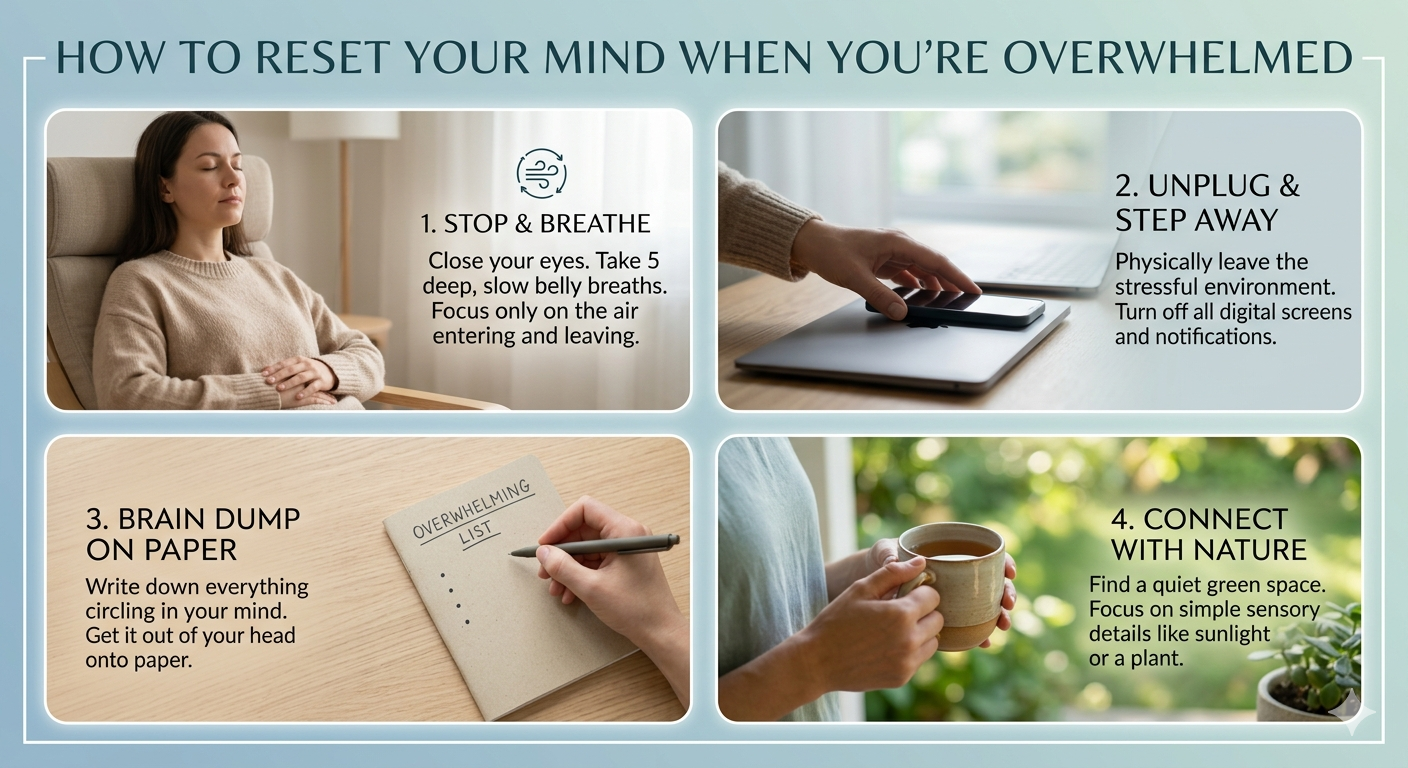
There is a particular kind of exhaustion that has nothing to do with how much sleep you got. Your body is rested but your mind is still running — replaying yesterday, pre-loading tomorrow, processing three conversations at once while you try to do something as simple as make coffee or read a single paragraph.
This is mental overwhelm. And the reason most advice about it does not help is that it treats the symptom — the tiredness, the scattered focus, the low mood — rather than the actual problem, which is that your mind has not had a genuine opportunity to reset.
A mental reset is not the same as a break. A break is stopping. A reset is the deliberate process of discharging accumulated mental load, returning your nervous system to a calmer baseline, and creating the kind of internal space that makes clear thinking, good decision-making, and genuine rest possible again.
This guide gives you a step-by-step mental reset process you can use today — whether you have ten minutes or two hours, whether you are sitting at your desk on a Thursday afternoon or lying on your bed at 11pm wondering why you cannot switch off.
Why Does Your Mind Get Overwhelmed in the First Place?
Before the reset, it helps to understand the mechanism — because once you understand why the overwhelm is happening, the steps to address it become obvious rather than arbitrary.
Your working memory has a limited capacity. Under normal conditions it manages your current task, holds a handful of pending items in the background, monitors emotional signals from your environment and relationships, and keeps a loose track of what needs to happen next. This is a significant workload even on an ordinary day.
The problem is that modern life rarely gives working memory the opportunity to offload what it is carrying. Unfinished tasks accumulate as open loops — items that your mind cannot file because they have not been resolved, so it keeps returning to them to check whether anything has changed. Every unanswered email, every pending decision, every unresolved conversation, every half-formed plan sits in the background consuming cognitive resources even when you are not consciously thinking about it.
Add to this the constant information input of screens, notifications, and news, and the emotional weight of whatever personal stressors are present in your life, and you have the conditions for mental overwhelm: a system running at or beyond its processing capacity, with no natural opportunity to clear.
The reset process works by systematically giving working memory the permission to offload — by externalising the open loops, discharging the physical tension that accumulated stress creates in the body, and creating the specific type of quiet that allows the deeper processing systems of the brain to do the integration work they are designed to do but rarely get the chance to.
If you recognise the pattern of feeling overwhelmed most heavily on Thursday or Friday, or the particular dread that builds on Sunday evenings, that timing is telling you something specific about your mental load accumulation pattern — and it is worth paying attention to. Our guide on what to do when you feel overwhelmed goes deeper into identifying the root causes underneath that feeling.
🌙 Your Moon Sign Explains a Lot About This
Everything above lives in your emotional world, and your Moon Sign is the closest thing astrology has to a map of exactly that: what genuinely soothes you, what sets you off, and what you actually need to feel secure. It takes two minutes to find yours.
Find My Moon Sign →What Does a Real Mental Reset Actually Involve?
A genuine mental reset has three distinct phases that need to happen in order. Most people attempt one or two of them and then wonder why they do not feel better. All three are necessary because they address different aspects of the problem.
The first phase is discharge — getting everything out of your head and onto something external so your working memory can stop holding it. The second phase is physical regulation — addressing the nervous system activation that sustained stress creates, because a cognitively clear mind sitting in a physiologically stressed body cannot actually rest. The third phase is deliberate empty space — the specific kind of quiet that allows the brain’s default mode network to process, integrate, and restore, which it can only do when you stop feeding it input.
Most resets skip phase two entirely, which is why they feel incomplete — you can empty your head through journaling and still feel tense, reactive, and unrested because the body is still holding what the mind started to release.
The steps below walk you through all three phases in a sequence that works whether you have a short window or a longer one.
Step 1 — Do a Complete Brain Dump
The first step of a genuine mental reset is to get everything out of your head and into a physical or digital list in a single unedited session. Not a to-do list. Not a prioritised action plan. A complete, unfiltered externalisation of everything your mind is currently holding.
Set a timer for ten minutes and write down everything — every task you know you need to do, every conversation you are processing or anticipating, every decision you have not made yet, every worry about something that might happen, every thing you told yourself you would not forget. Do not organise it. Do not judge what makes the list. Write until the timer ends or until you genuinely cannot think of anything else to add.
This step works because it converts open loops — the items working memory is continuously cycling through to make sure they are not forgotten — into closed loops. Once something is written down somewhere you trust, your brain is no longer responsible for holding it. Research from cognitive psychology consistently shows that the act of externalisation reduces cognitive load measurably, even when the items written down have not been acted upon at all. The relief is not from the problems being solved. It is from the mind no longer needing to hold them.
After your ten minutes, scan the list briefly and put a circle next to anything that genuinely needs attention today. Leave everything else untouched. You are not managing the list right now. You are emptying the container.
Before you reset your mind, it helps to first stop worrying about things you can’t control.
Step 2 — Move Your Body for Five Minutes
This step is not about exercise. It is about nervous system regulation — and it is the step most people skip, which is why their mental resets feel incomplete.
When your mind has been under sustained pressure, your body is holding the physiological signature of that pressure whether or not you are consciously aware of it. Elevated cortisol, mild muscle tension particularly in the shoulders, neck, jaw, and hands, shallow breathing, a low-level activation of the sympathetic nervous system that keeps the body in a mild but persistent state of readiness for threat. This is not dramatic. It is often subtle enough that you do not notice it as tension. You notice it as difficulty relaxing, as a background restlessness, as the sense of still feeling wound up even when there is objectively nothing to respond to.
Five minutes of deliberate physical movement is one of the fastest ways to discharge this physiological tension. Not a workout. Movement. Stand up, walk to a different room, do shoulder rolls, shake your hands out, walk around the block, stretch your neck slowly in both directions. The specific movement matters less than the intention: you are using physical activity to signal to the nervous system that the threat-readiness can downgrade, that the alertness that accumulated during the pressured period is no longer needed, that it is safe to begin returning to a calmer baseline.
If you have more time, a 15-20 minute walk outside is one of the single most effective mental reset tools available — combining movement, natural light exposure, and a change of environment in a way that addresses all three elements of physiological regulation simultaneously.
Step 3 — Use a Two-Minute Breathing Reset
After movement, a brief structured breathing practice anchors the nervous system regulation that movement began and creates a clear physiological marker between the overwhelmed state and the reset state.
The technique is simple. Inhale slowly through your nose for four counts. Hold for two counts. Exhale slowly through your mouth for six counts. Hold for two counts. Repeat this cycle six times. The entire practice takes approximately two minutes.
The extended exhale is the mechanism. Longer exhales than inhales directly activate the parasympathetic nervous system — the body’s calm and rest system — and create a measurable reduction in heart rate and cortisol within the first few cycles. This is not metaphor or placebo. It is a physiological lever that is always available to you, requires no equipment, and works within two minutes regardless of how depleted you feel.
For those who want to develop a deeper breathwork practice as an ongoing nervous system regulation tool rather than a single-use reset, our soma breathing guide covers a structured technique specifically designed to clear accumulated stress from the nervous system at a deeper level.
Step 4 — Identify the One Thing Actually Driving the Overwhelm
After you have emptied your working memory through the brain dump and regulated your nervous system through movement and breathing, there is often a moment of clarity in which the real source of the overwhelm becomes visible.
This step asks you to use that clarity. Look back at the list from your brain dump and ask: if there is one item on this list that is responsible for most of the underlying tension — the thing that is generating the most open loops, the most background anxiety, the most resistance — what is it?
It is almost always not the longest item on the list. It is usually one of the following: a decision you have been avoiding making, a conversation you know you need to have but have been postponing, a commitment you have overextended yourself on and have not yet acknowledged to yourself or anyone else, or a situation in your life that your conscious mind has been hoping will resolve itself without your direct attention.
Write that one thing down separately from the rest of the list. You do not need to solve it right now. You just need to name it clearly. The act of naming the actual source of overwhelm — rather than managing the diffuse anxiety it generates by staying busy — is one of the most relief-producing things available to you in a mental reset. Something that is named can be addressed. Something that remains unnamed continues to generate indefinite background tension.
Step 5 — Create Deliberate Empty Space
This is the step that the productivity-focused approach to mental resets almost always omits, because it looks like doing nothing. It is not doing nothing. It is the specific type of non-directed mental activity that allows your brain’s default mode network to process, integrate, and restore.
The default mode network is the brain system that activates during periods of mind-wandering, daydreaming, and restful non-directed thought. It is responsible for consolidating memories, making creative connections between disparate pieces of information, processing emotional experiences, and what neuroscientists call autobiographical reasoning — the ongoing process of making sense of your own experience and direction. It is, in short, the system that makes you feel like a coherent human being with a life that makes sense.
The problem is that the default mode network can only activate when you stop feeding your mind input. Scrolling, podcasts, background TV, conversations — all of these suppress it. The mind needs genuine quiet — not silence necessarily, but the absence of deliberate input — to enter the state in which restoration happens.
Ten to twenty minutes of deliberate empty space means: no phone, no content consumption, no task orientation. Sit with a cup of tea. Lie on the floor. Look out of a window. Go for a slow, aimless walk without earphones. Let your mind go wherever it wants to go without directing it. If thoughts from the brain dump arise, let them. If nothing arises, let that be enough. The practice is simply to stay in the space without filling it.
This is uncomfortable for most people, particularly those whose overwhelm pattern involves using constant activity to avoid the quieter discomfort of what the busy-ness was covering. The discomfort itself is information — and the willingness to stay with it rather than immediately filling the space is where the deepest part of the reset actually happens.
Step 6 — Set One Clear Intention Before Re-entering
A reset without a re-entry intention is a half-reset. Without this step, the renewed mental space tends to fill immediately with the same patterns that produced the overwhelm — the same over-scheduling, the same inability to say no, the same habit of treating every notification as an emergency requiring immediate response.
Before you re-engage with your tasks, your devices, or your responsibilities, take two minutes to set one clear intention for how you want to show up in the next period. Not a goal. An intention. The difference is that a goal is about what you want to produce or achieve. An intention is about how you want to be — the quality of attention and response you want to bring.
Examples: I will respond rather than react to whatever comes up in the next two hours. I will do one thing at a time and close it before opening the next. I will leave the office at a specific time and not check messages after that. I will say no to one thing today that I would normally say yes to out of obligation rather than genuine alignment.
The specificity of the intention matters. A vague intention to “be less stressed” has nothing to grip. A specific intention about one behaviour in one time period creates a real decision that the reset has given you the clarity to make and the capacity to keep.
If your overwhelm pattern is one that reliably rebuilds into the same heaviness by the end of each week, it is worth examining the structural conditions that produce it rather than only addressing it once it has arrived. Building a calming morning routine and learning how to identify the early signals of stress accumulation before it becomes overwhelm are two of the most effective preventive investments you can make.

How Long Does a Mental Reset Take?
The six-step process above takes approximately 30 to 40 minutes when done at a comfortable pace. But the individual steps are also modular — you can use any of them in isolation when a full reset is not possible.
If you have five minutes: steps 1 and 3. A quick brain dump and two minutes of structured breathing will move the needle on even severe overwhelm.
If you have ten minutes: steps 1, 2, and 3. Add the physical movement component and you get the benefit of nervous system regulation alongside the cognitive offloading.
If you have twenty minutes: the full sequence through step 5, arriving at the deliberate empty space. This is the minimum for a reset that genuinely reaches the restoration phase.
If you have an hour: the full sequence done slowly, with more time in step 5 and an additional walk or quiet period afterward. This is the reset that will feel complete — the kind where you genuinely notice that you think differently on the other side of it.
More on Relationships & Emotional Healing
If this resonated, these guides go deeper into the patterns, signs, and steps forward.
When Should You Do a Mental Reset?
The most useful answer is: before you feel like you need it. By the time overwhelm is severe, the reset takes longer, requires more convincing to actually do, and produces less complete results than a reset done earlier in the accumulation cycle.
The patterns that most reliably signal that a reset is approaching — before it arrives at full intensity — include increasing difficulty concentrating on one thing at a time, a lower-than-usual tolerance for interruption or change, the sense of going through motions rather than being genuinely present, and the specific experience of being tired but unable to rest.
If you recognise these signals on a Thursday or Friday afternoon, do the full reset before the weekend rather than carrying the accumulated load into it. The difference between a weekend that genuinely restores you and one that leaves you feeling vaguely worse is often just this: whether you gave your mind the opportunity to actually empty before the rest began.
The other high-value window for a mental reset is Sunday afternoon — before the Sunday scaries build into full dread. Our guide on why the Sunday scaries happen and how to break the cycle covers the specific Sunday reset techniques that work best for that particular anxiety pattern.
For the specific type of overwhelm that builds into Sunday evening dread — the mounting anxiety about the week ahead that prevents genuine rest — our full Sunday scaries guide addresses both the causes and the specific practices that break the cycle.
And for sustained stress that has been building across multiple weeks without adequate reset — the pattern that becomes burnout rather than temporary overwhelm — our guide on stress busters that actually work covers the practices that address accumulated stress at a deeper level than any single reset can reach.
Frequently Asked Questions
How do I reset my mind quickly when I am overwhelmed at work?
The fastest effective reset available in a work context is the combination of a two-minute brain dump and two minutes of slow breathing with extended exhales. This takes four minutes total and can be done at your desk, in a bathroom, or anywhere you can have two minutes of quiet. The brain dump externalises the open loops that are generating cognitive load, and the breathing activates the parasympathetic nervous system to lower cortisol. Together they create a meaningful shift in mental state even within very short time windows.
Why do I feel overwhelmed even when I am not particularly busy?
Overwhelm is not always proportional to objective workload. It is proportional to the ratio of input, open loops, and emotional weight relative to your current capacity. If you are sleeping poorly, carrying unresolved emotional tension, consuming high volumes of news or social media, or have been operating without genuine restoration for an extended period, your capacity is reduced — meaning a workload that would normally be manageable produces overwhelm. The reset process addresses capacity directly rather than just reducing the workload, which is why it often produces relief that changing your schedule alone does not.
Is a mental reset the same as meditating?
They overlap but are not identical. Meditation is a specific practice of sustained present-moment attention or awareness, typically done in a relatively formal context with a consistent technique. A mental reset is a broader process that includes cognitive offloading (brain dump), physical regulation (movement and breathing), and deliberate empty space — of which meditation can be one form, but is not the only one. People who find formal meditation difficult often find the mental reset process more accessible because it includes active steps before the quiet phase, which makes the quiet phase easier to enter.
How often should I do a mental reset?
The useful answer depends on your pattern. For people who reliably accumulate significant mental load across a working week, one full reset per week — ideally on Thursday or Friday before the weekend — combined with shorter versions (steps 1 and 3) on any day that feels particularly heavy. For people in periods of sustained high pressure, a short daily reset of ten minutes in the morning or at the end of the working day maintains a lower baseline that prevents the full overwhelm state from developing as frequently.
CLOSING PARAGRAPH
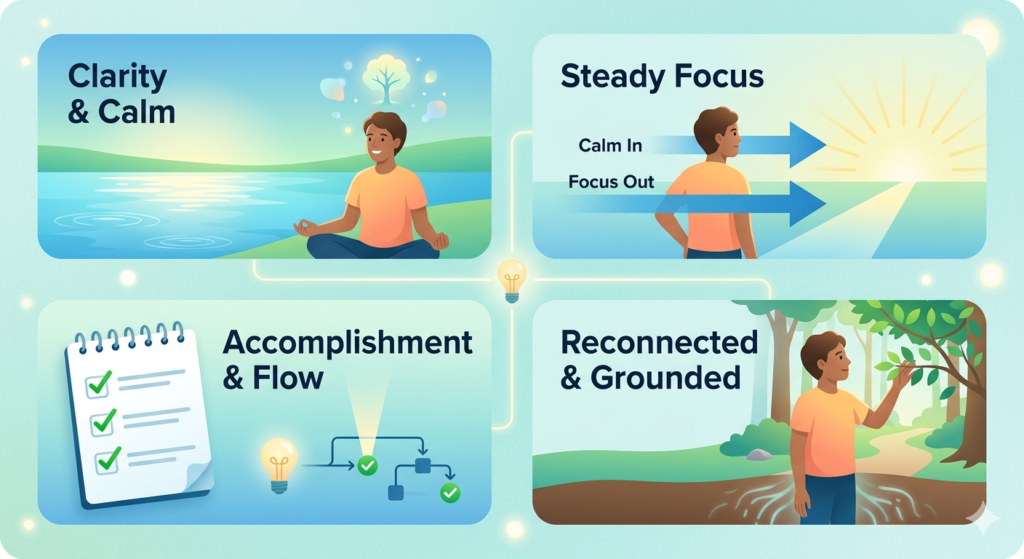
Your mind is not a machine that can be forced to perform through exhaustion by sheer determination. It is a system with real capacity limits, real restoration requirements, and the genuine ability to return to clarity and calm when given what it actually needs to do so.
The reset is not a luxury. It is maintenance. And the difference between a mind that is constantly running on empty and one that has the space and capacity to think clearly, make good decisions, and actually experience the life it is working so hard to build — that difference is often just this: whether you are willing to stop long enough to let it reset.
Recent Posts
- Best Skincare Routine for a Natural Glow (Morning & Night)
- Hair Glow Up: Grow Healthier Hair From the Inside Out
- Digital Mental Health: A Complete, Evidence-Based Guide to Apps, Therapeutics, and Telehealth
- How Teens Can Start Freelance Writing With No Experience
- Aquarius Zodiac Sign: Personality, Love, Career & Compatibility