
Quick Answer
What's the Fastest Way to Calm Anxiety?
The fastest way to calm anxiety is a physical one, not a mental one — a longer exhale than inhale, cold water on your face or wrists, or 2 minutes of movement all work faster than trying to "think" your way calm. This guide covers 10 core techniques plus scenario-specific tips for anxiety at work, anxiety attacks specifically, and a few bonus quick methods — all natural, all under 5 minutes, no app or medication required.
Techniques Covered
10 Core + Bonus
Time Needed
Under 5 Minutes
Best For
Panic Spikes • Racing Thoughts
Approach
100% Natural, No Meds
Also Covers
At Work • Anxiety Attacks
Your heart is racing. Your thoughts are jumping from one worst-case scenario to the next. Your chest feels tight and you cannot quite catch a full breath. You need to calm down — and you need it to happen now, not after a 30-minute meditation session.
If that sounds familiar, you are in the right place.
Learning how to calm anxiety fast is one of the most useful things you can do for your mental health. Not because anxiety is a problem to eliminate — it is a natural response your body uses to signal danger. But when anxiety fires at the wrong time, over the wrong things, with the wrong intensity, you need practical tools that work quickly.
Every technique in this guide takes under 5 minutes. None of them require an app, a therapist, or a quiet room. They work in your car, at your desk, in a bathroom stall, or lying in bed at 2am. Start with the first one right now if you need to. For a deeper look at which anxiety apps are actually evidence-based versus just popular, see our complete guide to digital mental health.
✨ No Sponsorships. No Fluff.
The Free Self-Care Apps Actually Worth Keeping on Your Phone
We tested the ones everyone recommends, and skipped the ones that are just pretty wallpaper. Here's what actually helps on the days you need it most.
See the Free List →Why Anxiety Spikes So Suddenly
Anxiety feels sudden because of how your nervous system works. When your brain perceives a threat — even an imagined one like a difficult conversation ahead or a deadline looming — it activates your fight-or-flight response. Cortisol and adrenaline flood your body. Your heart rate increases, your breathing shallows, and your muscles tense.
The problem is that your brain cannot always distinguish between a real physical threat and a stressful thought. It responds the same way to both.
This is why calming anxiety fast requires working with your nervous system directly — through your breath, your body, and your senses — rather than just telling yourself to “calm down.” Telling yourself to calm down without a physical anchor almost never works. The techniques below give your nervous system something real to respond to.
If you find that anxiety hits you hardest in the morning before your day has even started, it helps to also build a foundation the night before and the moment you wake up. Our guide on building a morning routine for anxiety walks through exactly how to do that.
💙 Do you get Anxious easily? Read these helpful guides
Measure how stressed you really are — free PSS-10 assessment, 3 minutes, no sign-up.
Is This an Anxiety Attack, or Just Anxiety?
If what you’re feeling right now is more intense than the usual racing thoughts — a sudden wave of chest tightness, shortness of breath, or a feeling that something is seriously wrong — you may be dealing with an anxiety attack rather than everyday anxiety. The distinction matters less than you’d think for what to actually do next: every technique in this guide works for both, since they all target the same physical response, just at different intensities.
The main difference is how quickly and forcefully the symptoms hit. Everyday anxiety tends to build gradually and stays at a manageable simmer. An anxiety attack arrives faster and feels harder to think your way out of — which is exactly why the physical techniques below (cold water, breath ratio, grounding) tend to work better in the moment than anything that requires calm, clear thinking to execute.
🌿Do you get stressed easily? Read these helpful guides
Not sure how stressed you actually are? Take the free PSS-10 test — 10 questions, instant score.
🧠 Check My Stress Level →10 Techniques to Calm Anxiety Fast
1. The 4-7-8 Breathing Technique
This is the fastest physiological way to reduce anxiety and it works within 60 seconds for most people.
Here is how to do it: Inhale through your nose for 4 counts. Hold your breath for 7 counts. Exhale slowly through your mouth for 8 counts. Repeat this cycle 3 to 4 times.
The extended exhale is the key. A longer exhale than inhale directly activates your parasympathetic nervous system — your body’s calm-down system. It signals to your brain that the threat has passed and it is safe to relax. You will feel your heart rate begin to slow within the first two cycles.
Do this before a difficult conversation, during a panic spike, or anytime your thoughts start spiralling faster than you can manage them.
✨ The Complete Glow Up Guide
Skin, hair, and the habits behind both. Start with whichever part of your glow up matters most to you.
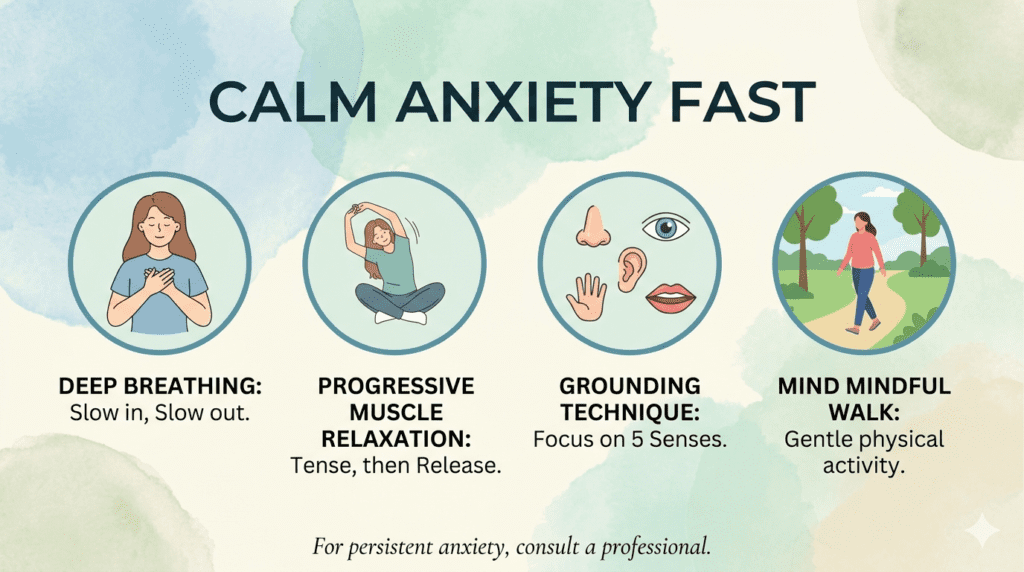
2. The 5-4-3-2-1 Grounding Method
Anxiety pulls you out of the present moment and into a future that has not happened yet. Grounding techniques bring you back to right now by engaging your senses.
The 5-4-3-2-1 method works like this: Name 5 things you can see. Name 4 things you can physically touch. Name 3 things you can hear. Name 2 things you can smell. Name 1 thing you can taste.
Say them out loud if you can, or say them silently if you are in a public space. The act of deliberately noticing your immediate environment interrupts the anxiety loop and returns your nervous system to the present.
This technique is particularly effective for anticipatory anxiety — the kind that builds before something stressful happens rather than during it.
Many anxiety spikes come from worrying about things you can’t control — here’s how to stop it before it escalates.😄 Need a Happiness Boost?
Habits, quotes, and daily moments to help you feel a little lighter today.
🧠 If happiness feels out of reach lately, stress might be the real reason why.
Check My Stress Level →3. Cold Water on Your Face or Wrists
This one sounds too simple to work. It is not.
Splashing cold water on your face or holding your wrists under cold running water triggers what is known as the dive reflex — a physiological response that slows your heart rate almost immediately. It is the same mechanism that activates when you submerge your face in cold water.
If you are at home, fill a bowl with cold water and ice and briefly submerge your face for 15 to 30 seconds. If you are at work or in public, cold water on the inner wrists and back of the neck works well. This technique is especially effective during a panic spike when your heart is racing and breathing techniques feel difficult to focus on.
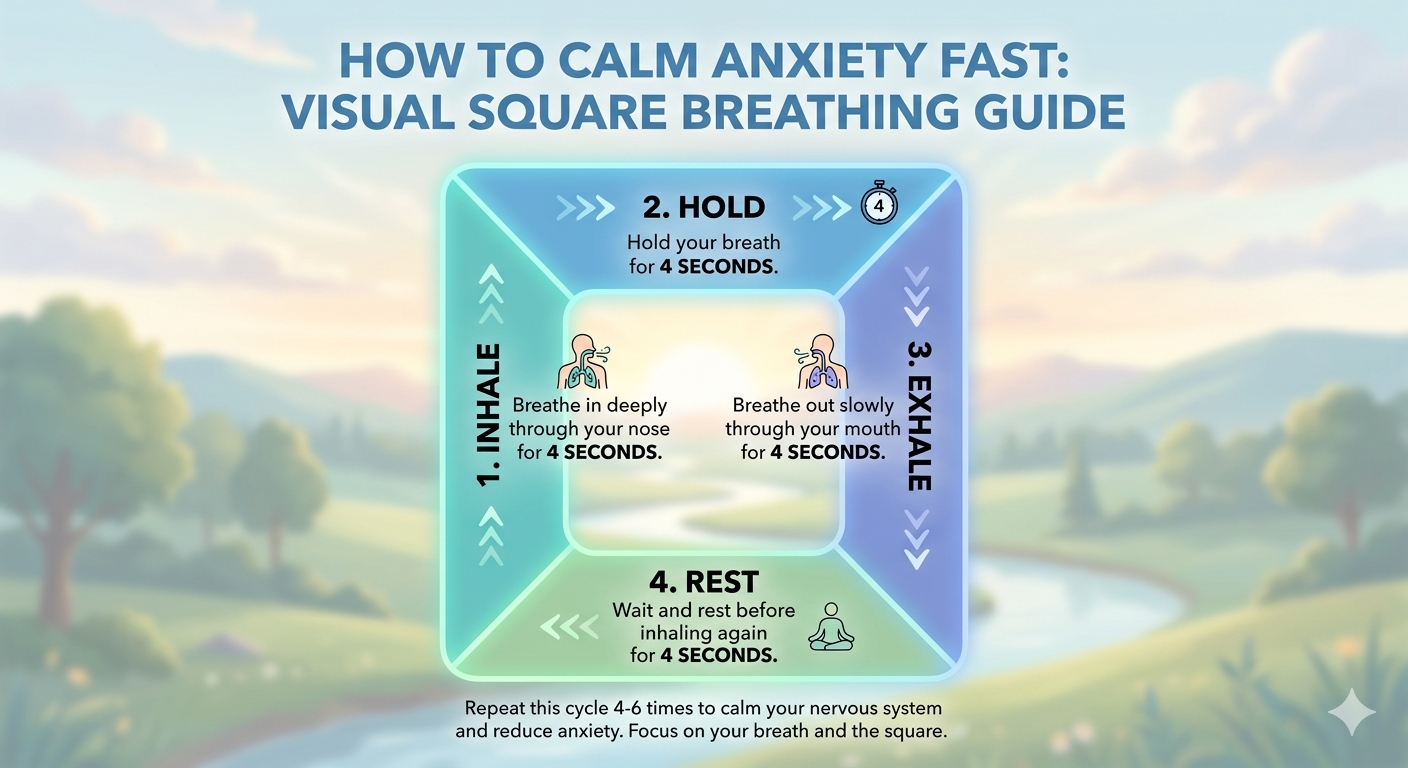
4. Box Breathing
Box breathing is used by military personnel, surgeons, and athletes to stay calm under pressure. It is structured, simple, and takes exactly 2 minutes to complete a full cycle.Inhale for 4 counts. Hold for 4 counts. Exhale for 4 counts. Hold for 4 counts. That is one box. Repeat 4 times.
The equal counts on every side create a predictable rhythm that your nervous system naturally synchronises with. Unlike the 4-7-8 method which is better for acute spikes, box breathing is excellent for sustained anxiety — the low-level tension that sits in your chest all day.
For a deeper breathwork practice that addresses anxiety at a nervous system level, our guide on soma breathing explains a structured technique used specifically to release stored stress from the body.
5. Progressive Muscle Relaxation (The 2-Minute Version)
Anxiety lives in your body as much as your mind. When you are anxious, your muscles hold tension — often without you noticing. Progressive muscle relaxation deliberately releases that tension.
The fast version: Start with your hands. Clench them as tight as you can for 5 seconds, then release completely. Notice the difference. Move to your shoulders — hunch them up to your ears, hold for 5 seconds, release. Then your jaw — clench, hold, release. Finally your legs — tense every muscle from your thighs to your feet, hold, release.
That is it. Four muscle groups, under 2 minutes, and your body will feel measurably less tense by the end. The physical release sends a direct signal to your brain that the threat response can downgrade.
6. Name What You Are Feeling
This technique comes from neuroscience research and it works because of how your brain processes emotion.
When anxiety spikes, activity in your amygdala — the brain’s alarm system — increases. Studies from UCLA found that simply labelling an emotion in words reduces amygdala activity and shifts processing to the prefrontal cortex, the rational part of your brain.
So instead of trying to stop the anxiety, name it specifically. Not just “I feel anxious” but “I feel anxious because I am worried about how tomorrow’s meeting will go and I am not sure I am prepared.” The more specific you are, the more effective this technique is. Naming transforms a vague overwhelming feeling into a specific, manageable thought.
7. Move Your Body for 2 Minutes
You do not need a workout. You need movement.
Anxiety is your body preparing to either fight or flee — it is energy that has nowhere to go. Two minutes of physical movement gives that energy an outlet. Walk briskly around the room. Do 20 jumping jacks. Shake your hands out vigorously. Roll your neck and shoulders slowly in wide circles.
The movement does not need to be intense. It just needs to be physical. Even standing up and walking to a different room changes your physiological state enough to interrupt an anxiety spiral.
8. Repeat a Calming Anchor Phrase
An anchor phrase is a short sentence you repeat to yourself during an anxiety spike to activate a calmer mental state. It works through a combination of focused attention and self-regulation.
Effective anchor phrases are grounded and realistic — not toxic positivity. “I am safe right now.” “This feeling will pass.” “I have been here before and I got through it.” “I do not need to solve everything today.”
Choose one phrase before you need it. Practise saying it on ordinary days so your nervous system builds an association between the phrase and calm. When anxiety spikes, it will work faster because the neural pathway is already established.
9. Slow Your Exhale to Twice Your Inhale
This is the simplified version of breathwork for moments when a structured technique feels like too much to follow.
Simply breathe in for any count — 3, 4, or 5 — and breathe out for exactly double that count. Inhale for 4, exhale for 8. Inhale for 3, exhale for 6.
That is the entire technique. The ratio is what matters. A longer exhale than inhale consistently activates the parasympathetic response regardless of the exact count. If the 4-7-8 method feels too structured when you are mid-spiral, start here.
10. Step Outside for 5 Minutes
Natural light, fresh air, and a change of environment have a measurable effect on cortisol levels and anxiety intensity. You do not need a park or a scenic view — a footpath outside your office building or a few minutes in your garden works the same way.
The combination of natural light (which regulates cortisol), mild physical movement (walking), and environmental change (new visual stimuli) creates a rapid shift in your nervous system state that no indoor technique fully replicates.
If stepping outside is not possible, opening a window and standing in front of it for 5 minutes achieves a similar effect.
How to Calm Anxiety at Work Without Anyone Noticing
Most of the techniques above work fine at a desk, but a few need adjusting when you can’t excuse yourself to lie on the floor or splash water on your face in front of your team. A few discreet options: run cold water over your wrists in the bathroom rather than your face, since it’s just as effective and completely unnoticeable once you’re back at your desk. Box breathing works well seated with your eyes open — nobody can tell you’re doing it, unlike a technique that requires closing your eyes. If a meeting is triggering the spike, excusing yourself for “water” or “the restroom” buys you two minutes for the 4-7-8 technique or the exhale-ratio method, both of which work seated and silently.
If work anxiety isn’t a one-off spike but a daily pattern building before you even get there, it’s worth addressing the mornings themselves rather than only the symptoms once you arrive — our guide on building a morning routine for anxiety covers exactly that.
A Few More Quick Techniques Worth Trying
The 10 techniques above cover the most well-supported options, but a few other quick methods are worth having in your back pocket too. Chewing gum gives your jaw somewhere to release tension and can interrupt a spiral simply by giving your body a repetitive physical task. EFT tapping — gently tapping specific points on your hand, wrist, or collarbone while naming what you’re feeling — combines the naming technique from above with a physical action, and plenty of people find the combination more effective than naming alone. A warm cup of chamomile tea won’t stop a spike in progress, but it’s a reasonable low-effort addition to an evening wind-down if anxiety tends to hit at night. Journaling for even 60 seconds — just dumping the racing thoughts onto a page without editing them — gets them out of your head and onto something external, which alone reduces their intensity for a lot of people. And if you have a pet nearby, a few minutes with them measurably lowers cortisol for most people — it’s one of the simplest tools on this list and often the most overlooked.
📱 5 Free App Guides for Your Mind & Mood
No paywalls, no trials that quietly start charging you — just genuinely free tools, hand-picked and reviewed.
🧠 Not sure how stressed you actually are? Find out in 3 minutes.
Check My Stress Level →When Fast Techniques Are Not Enough
These 10 techniques are designed for acute anxiety moments — spikes that come and go. They are not a substitute for addressing the underlying patterns that cause anxiety to keep returning.
If you notice that anxiety is hitting you at the same time every day, before the same types of situations, or building into something that is affecting your sleep, your relationships, or your ability to function, that is a signal worth paying attention to.
Sometimes anxiety is telling you something specific. It might be telling you that your current pace is not sustainable. It might be telling you that you have been ignoring your own needs for too long. It might be telling you that you need a full mental reset rather than a 5-minute technique.
If you recognise that pattern, our guide on signs you need a mental health day helps you identify when your mind and body are asking for something deeper than a quick fix.
And if anxiety has built into a full sense of being overwhelmed — where everything feels like too much, and you do not know where to start — read our step-by-step guide for when you feel overwhelmed before trying to push through on your own.
If your anxiety has a consistent relational source — the chronic discomfort of unexpressed needs, the tension of consistently doing things you did not want to do — the fast-relief tools in this guide are useful for the acute moments, but the structural work is learning to set boundaries in a relationship without the guilt that usually stops you.
Which Technique Should You Start With?
If your heart is racing right now: start with cold water on your wrists or the 4-7-8 breathing technique. These work fastest on physical anxiety symptoms.
If your thoughts are racing but your body feels okay: start with the 5-4-3-2-1 grounding method or naming your feeling specifically. These interrupt the cognitive spiral most effectively.
If anxiety is low-level and persistent throughout the day: box breathing and progressive muscle relaxation work best because they address sustained tension rather than acute spikes.
If you are anxious and exhausted: step outside. Movement and light reset both the body and the mind faster than any breathing technique when you are depleted.
You do not need to use all 10. You need to find 2 or 3 that work for your specific anxiety pattern and practise them before you need them, so they are already familiar when a spike arrives.
🔮 Explore More Free Numerology & Astrology Tools
Free calculators and guides — no sign-up required
🧭
Life Path Number Calculator
Find the number that shapes your entire life journey from your date of birth
👼
Angel Number Calculator
Discover your personal angel number by birth date or name
🎨
Lucky Color Calculator
Find your zodiac sign's lucky colour by date of birth
✨
Angel Numbers Guide
What repeating numbers like 444, 1111 and 222 mean for you right now
📚
Numerology Hub
All guides, calculators and explainers in one place
Frequently Asked Questions
What is the fastest way to calm anxiety?
The fastest physiological way to calm anxiety is a controlled exhale that is longer than your inhale. Try inhaling for 4 counts and exhaling for 8 counts. This directly activates your parasympathetic nervous system and begins reducing your heart rate within 60 seconds. Cold water on your face or wrists is the second-fastest method, triggering a dive reflex that slows heart rate almost immediately.
Can anxiety go away on its own without doing anything?
Yes — anxiety is a temporary physiological state and it will pass even without intervention. However, doing nothing while anxious often prolongs the spike because your attention stays focused on the anxiety itself, which keeps the nervous system activated. Using even one grounding or breathing technique shortens the duration of an anxiety spike significantly.
Why does telling yourself to calm down not work?
Because your nervous system does not respond to instructions — it responds to physical signals. When anxiety activates your fight-or-flight response, your rational mind loses direct control over your heart rate, breathing, and muscle tension. Breathing techniques, cold water, and physical movement work because they give your nervous system a direct physical signal to downregulate, bypassing the rational mind entirely.
How do I calm anxiety at night when I cannot sleep?
The 4-7-8 breathing technique and progressive muscle relaxation are the most effective techniques for nighttime anxiety because they can be done lying down in the dark. Avoid the 5-4-3-2-1 technique at night as actively scanning your environment can increase alertness. If nighttime anxiety is a recurring pattern, building a consistent wind-down routine addresses the root cause rather than just the symptoms.
Is it possible to stop anxiety completely?
Not completely — and that is not the goal. Anxiety is a functional part of your nervous system that helps you respond to real threats and stay motivated. The goal is to reduce the frequency of false alarms, shorten the duration of anxiety spikes, and prevent anxiety from interfering with your daily life. The techniques in this guide help with all three.
When should I see a doctor about anxiety?
If anxiety is occurring most days, lasting for weeks at a time, or preventing you from doing things you want to do — working, socialising, sleeping, or making decisions — it is worth speaking to a doctor or mental health professional. Fast techniques manage acute moments but persistent anxiety that affects daily functioning benefits from professional support, which may include therapy, medication, or both.
How do you get rid of anxiety fast?
The fastest results come from techniques that work on your body directly rather than your thoughts — cold water on your face or wrists, a longer exhale than inhale, or 2 minutes of physical movement. These bypass the need to “think” your way calm, which is usually the hardest part when anxiety is already high.
How can I reduce anxiety naturally without medication?
All 10 core techniques in this guide, plus the bonus methods above, are entirely natural and drug-free — breathing patterns, cold exposure, grounding, movement, and journaling all work through your nervous system directly, without needing medication. For anxiety that’s frequent or severe, natural techniques are a strong first step, but see the section above on when it’s worth speaking to a doctor as well.
How is an anxiety attack different from everyday anxiety?
An anxiety attack tends to hit faster and more intensely than everyday anxiety, with symptoms like chest tightness or shortness of breath arriving suddenly rather than building gradually. The techniques for managing both are the same — physical, not mental — but during an anxiety attack, starting with the fastest options (cold water, the 4-7-8 breath) tends to work better than techniques requiring focused thought.
What can I do to calm anxiety at work without anyone noticing?
Cold water on your wrists in the bathroom, box breathing with your eyes open at your desk, and stepping out for “water” to do a quick breathing technique are all discreet enough that colleagues won’t notice anything unusual. See the full section on calming anxiety at work above for more detail.
From calming anxiety to finding your angel number — everything here is free, practical, and written to actually help.
Final Thought
Anxiety does not have to take over a moment, a morning, or a day. The techniques in this guide are tools you already have access to — your breath, your body, and your attention. The more you practise them on ordinary days, the more automatic they become when you actually need them.
Start with one technique today. Not when the next anxiety spike arrives — now, when you are calm, so your nervous system already knows the way.
If your anxiety spikes follow a predictable weekly pattern — building through Sunday afternoon and evening every single week — the techniques in this guide work for the acute moments, but our Sunday scaries guide addresses the underlying cycle that makes them predictable in the first place.
Recent Posts
- 25 Aura Colors and Their Meanings: Chart, Shades and How to Find Yours
- Best Freelance Skills for Teens in 2027: 12 Skills to Learn First (and How to Choose)
- Best Homework Help Websites in 2027: 25 Free and Paid Sites for Every Subject
- How to Build a Writing Portfolio as a Teen With No Experience
- Best Skincare Routine for a Natural Glow (Morning & Night)